


Editors Pick
Latest Article

Canada vs. Australia for IT Professionals: Which Country Should You Choose?
Canada vs. Australia for IT Professionals: Which Country Should You Choose?
Both Canada and Australia offer IT professionals career opportunities in software engineering, cybersecurity, cloud computing and data analytics, with competitive salaries and pathways to permanent residency (PR). Australia offers skilled migration options through Subclass 189 and 190 visas, alongside employer-sponsored pathways through Subclass 482 and 186. Canada provides PR routes through Express Entry and Provincial Nominee Programs (PNPs). Explore how the two countries compare in IT job opportunities, salaries, work visa options, PR pathways, taxes and living costs to find the right destination for your IT career and future settlement.
*Want to work abroad? Let Y-Axis help you through application process.
Canada vs. Australia for IT Professionals: Quick Comparison
| Factor | Canada | Australia |
|---|---|---|
| Average Annual IT Salary | CAD 80,000–150,000 | AUD 90,000–180,000 |
| Estimated IT Job Vacancies for the Next 10 Years | 150,000+ | 250,000+ |
| In-Demand IT Job Roles | Software developers, software engineers, cybersecurity specialists, cloud engineers, data scientists and AI/ML specialists | Software developers, software engineers, cybersecurity specialists, cloud engineers, data analysts and ICT managers |
| Major Cities for IT Jobs | Toronto, Vancouver, Ottawa, Montréal and Calgary | Sydney, Melbourne, Brisbane, Canberra and Perth |
| Fast-track Hiring Pathways | Global Talent Stream | Skills in Demand visa (subclass 482) |
| Work Visa Options | Employer-specific work permits and other work permit pathways | Skills in Demand visa (subclass 482), Skilled Independent visa (subclass 189), Skilled Nominated visa (subclass 190) and Skilled Work Regional visa (subclass 491) |
| Permanent Residency Pathways | Express Entry and Provincial Nominee Program (PNP) | Skilled Independent visa (subclass 189), Skilled Nominated visa (subclass 190) and employer-sponsored pathways |
| Estimated Monthly Living Costs | CAD 2,500–4,200 | AUD 2,800–4,700 |
| Family Migration Options | Include your spouse and dependent children in permanent residence applications | Include your spouse and dependent children in visa applications that allow family members |
Canada vs. Australia: Which Country Offers Better Opportunities for IT Professionals?
Australia offers IT professionals competitive salaries, 12% employer superannuation contributions and four weeks of paid annual leave for most full-time employees. Cities such as Sydney, Melbourne and Brisbane offer opportunities in software engineering, cybersecurity and cloud computing. Canada also attracts IT talent through technology hubs and PR pathways such as Express Entry and Provincial Nominee Programs (PNPs). Both countries offer strong career prospects for IT professionals, with Australia providing skilled migration and employer-sponsored visa pathways.
Canada may be good choice if you:
- Want to pursue PR through Express Entry or a Provincial Nominee Program (PNP).
- Have strong English or French skills and a competitive CRS score.
- Are targeting IT jobs in Toronto, Vancouver, Montréal or Ottawa.
- Want to explore opportunities in software development, AI, cloud computing or cybersecurity.
*Want to work in Canada? Get expert guidance from Y-Axis professionals.
Australia may be good choice if you:
- Have an IT occupation suited to a skilled migration pathway.
- Can obtain a positive skills assessment for your nominated occupation.
- Meet the points requirements for a subclass 189 or 190 visa, or have an employer willing to sponsor you.
- Want employer superannuation contributions and four weeks of paid annual leave for most full-time employees.
*Want to work in Australia? Get expert guidance from Y-Axis professionals.
Canada vs. Australia: Salary, Living Costs & Savings for IT Professionals
Salaries, taxes and living costs are key factors when comparing IT careers in Australia and Canada. Australia offers 12% employer superannuation contributions and four weeks of paid annual leave for most full-time employees. Comparing IT salaries and everyday expenses in cities such as Sydney, Melbourne, Toronto and Calgary can help you understand your potential take-home pay and savings in each country.
| Factor | Canada | Australia |
|---|---|---|
| Annual IT Salary (Before Tax) | CAD 70,000–150,000 | AUD 90,000–170,000 |
| Monthly Gross Salary | CAD 5,833–12,500 | AUD 7,500–14,167 |
| Estimated Monthly Take-Home Pay | CAD 4,400–8,700 | AUD 5,800–10,300 |
| Monthly Rent (1-Bedroom Apartment in City Centre) | CAD 1,300–2,650 | AUD 1,470–3,620 |
| Monthly Grocery Expenses | CAD 350–550 | AUD 400–650 |
| Monthly Public Transport Expenses | CAD 100–180 | AUD 100–220 |
| Monthly Utilities, Internet and Mobile | CAD 150–300 | AUD 260–500 |
| Estimated Total Monthly Living Expenses | CAD 1,900–3,700 | AUD 2,200–5,000 |
| Potential Monthly Savings | CAD 700–6,800 | AUD 800–8,100 |
| Potential Annual Savings | CAD 8,400–81,600 | AUD 9,600–97,200 |
| Cities with Relatively Lower Living Costs | Calgary, Edmonton and Montréal | Adelaide, Perth and Brisbane |
| Major Higher-Cost IT Hubs | Toronto and Vancouver | Sydney and Melbourne |
*Plan Your IT Career Abroad? Book a Free Consultation with Y-Axis Today.
FAQs;
Is Australia or Canada better for IT professionals?
Australia offers skilled migration visas, employer sponsorship and employment benefits such as superannuation. Canada offers IT jobs in Toronto, Vancouver and Montréal, along with PR pathways through Express Entry and Provincial Nominee Programs (PNPs). The better choice depends on your career goals, salary expectations and migration eligibility.
Which country offers higher IT salaries, Australia or Canada?
IT professionals in Australia can earn AUD 90,000–170,000 annually, while salaries in Canada range from CAD 70,000–150,000. Actual earnings depend on your role, experience and location.
Which IT jobs are in demand in Australia and Canada?
Both countries offer opportunities for software developers, cybersecurity analysts, cloud engineers, data scientists and IT managers. Major IT hubs include Sydney, Melbourne and Brisbane in Australia, and Toronto, Vancouver and Calgary in Canada.
How can IT professionals get PR in Australia or Canada?
Australia offers Subclass 189, 190 and 491 skilled migration visas, while Canada offers PR through Express Entry and Provincial Nominee Programs (PNPs). Eligibility depends on your occupation, qualifications, work experience and language proficiency.
Is Australian PR or Canadian PR easier for IT professionals?
Neither country is easier for everyone. Australia considers points, occupation eligibility and skills assessments where applicable. Canada ranks eligible Express Entry candidates using the Comprehensive Ranking System (CRS). Your profile and current selection criteria determine your prospects.
How many points do IT professionals need for Australian skilled migration?
Applicants for Australia's points-tested Subclass 189 visa generally need at least 65 points to qualify for consideration. However, meeting this minimum does not guarantee an invitation.
Is an ACS skills assessment required for IT professionals migrating to Australia?
Many IT professionals applying through Australian skilled migration need an assessment from the Australian Computer Society (ACS) when it is the designated assessing authority for their nominated occupation. Requirements depend on the occupation and visa pathway.
Can IT professionals migrate to Australia or Canada without a job offer?
Yes. Eligible applicants can pursue Australia's Subclass 189 visa or qualifying Canadian Express Entry pathways without a job offer. Other visa options may require employer sponsorship or a qualifying job offer.
Is the cost of living lower in Australia or Canada for IT professionals?
Adelaide and Perth can be alternatives to Sydney in Australia, while Calgary and Montréal can be alternatives to Toronto and Vancouver in Canada. Compare rent, transport, groceries and utilities in your target city.
Which country offers better savings for IT professionals, Australia or Canada?
Your savings depend on your after-tax salary and living expenses. Compare equivalent IT salaries, rent, groceries, transport and taxes in your preferred cities. Australia's 12% employer superannuation contribution also supports retirement savings but is separate from take-home pay.
Posted on October 19 2026

How Can I Get Permanent Residency in Germany?
How Can I Get Permanent Residency in Germany?
To get permanent residency in Germany, you must meet the eligibility requirements for a settlement permit (Niederlassungserlaubnis). Most applicants can qualify after five years of legal residence, while skilled workers may apply after three years and EU Blue Card holders can apply after 21 months with B1-level German or 27 months with A1-level German. Applicants must also meet the applicable requirements for employment, income, pension contributions, German language proficiency and adequate housing. Meeting these requirements can help you secure long-term residence and build your future in Germany.
*Want to apply for Germany PR? Let Y-Axis guide you through the application process.
Germany Permanent Residency Pathways
There are five main pathways to permanent residency in Germany: the Standard Settlement Permit, EU Blue Card, Skilled Worker Residence Permit, German university graduate route and self-employment route. Each pathway has different residence periods and eligibility requirements based on your employment, qualifications, income and German language proficiency.
- Standard Settlement Permit: For applicants who have generally lived in Germany for five years and meet the income, pension contribution, German language and housing requirements.
- EU Blue Card: Eligible holders can apply after 21 months of qualifying employment with B1-level German or 27 months with A1-level German.
- Skilled Worker Residence Permit: Skilled workers can generally apply after three years of holding a qualifying residence permit, with the required employment history, pension contributions and German language skills.
- German University Graduates: Graduates of German universities may qualify after two years of skilled employment in Germany and 24 months of pension contributions.
- Self-Employed Individuals: Business owners may qualify after three years of successful self-employment provided their business is sustainable and generates sufficient income to support their livelihood.
Who is Eligible for Germany Permanent Residency?
Eligibility for permanent residency in Germany depends on your residence permit and employment status. Most applicants can qualify after five years of legal residence, while eligible skilled workers may apply after three years and EU Blue Card holders after 21 or 27 months, depending on their German language proficiency. Applicants must also meet the applicable requirements for income, pension contributions and adequate housing.
- Residence period: Generally five years for the standard route, three years for eligible skilled workers, and 21 months or 27 months for eligible EU Blue Card holders.
- Employment: Hold a qualifying residence permit and meet the employment requirements for your pathway.
- Pension contributions: Provide proof of the required contributions to Germany’s statutory pension insurance.
- Financial stability: Earn sufficient income to cover your living expenses and those of your dependants.
- German language skills: Meet the required language level, which varies by pathway.
- Housing: Have adequate accommodation for yourself and your family.
- Integration: Meet any applicable integration or civic knowledge requirements.
- Legal requirements: Satisfy the relevant legal conditions for obtaining a settlement permit.
*Need help with Germany PR requirements? Book a free consultation with Y-Axis today.
Documents Required for Germany PR
Germany PR requires a valid passport, current residence permit, proof of employment and income, pension contribution records, health insurance and proof of adequate housing. Applicants may also need German language and integration certificates, depending on their residence permit category. Additional documents may be requested by the local immigration authority.
- Valid passport: A current passport confirming your identity and nationality.
- Current residence permit: A valid German residence permit, such as an EU Blue Card or Skilled Worker Residence Permit.
- Completed application form: The settlement permit application form issued by your local immigration authority.
- Employment contract: Proof of qualifying employment, where required.
- Recent payslips: Salary statements showing your regular employment income.
- Pension contribution record: Evidence of the required contributions to Germany’s statutory pension insurance.
- German language certificate: Proof of the required German proficiency level, where applicable.
- Proof of accommodation: A rental agreement or other evidence of adequate housing.
- Health insurance certificate: Proof of valid health insurance coverage in Germany.
- Integration certificate: Evidence of completing an integration course or meeting applicable civic knowledge requirements, where required.
- Proof of financial resources: Documents showing that you can cover your living expenses and those of your dependants.
How to Apply for Germany PR?
To apply for permanent residency in Germany, you must check your eligibility, prepare the required documents and submit your settlement permit (Niederlassungserlaubnis) application to the local immigration authority (Ausländerbehörde). The process involves an appointment, document verification and payment of the applicable fee.
Step 1: Check your eligibility
Confirm that you meet the required residence period, employment, income, pension contribution and German language requirements for your residence permit category.
Step 2: Gather the required documents
Prepare your passport, current residence permit, employment contract, payslips, pension contribution records, health insurance proof and other supporting documents.
Step 3: Book an appointment
Contact your local immigration authority (Ausländerbehörde) to check the application procedure and schedule an appointment.
Step 4: Submit your application
Complete the settlement permit application form and submit it with the required documents.
Step 5: Attend your appointment
Present your original documents and provide biometric information if requested.
Step 6: Pay the application fee
Pay the applicable fee for your settlement permit category.
Step 7: Wait for a decision
The immigration authority reviews your application and may request additional documents before making a decision.
Step 8: Receive your settlement permit
Once your application is approved, follow the authority’s instructions to collect your residence permit card.
*Want to apply for Germany PR? Book a free consultation with Y-Axis today.
Cost of Germany Permanent Residency
The cost of permanent residency in Germany depends on the type of settlement permit. The application fee is generally €113 for a standard settlement permit, €147 for highly qualified applicants and €124 for self-employed applicants.
| Applicant Category | Application Fee |
|---|---|
| Standard settlement permit | €113 |
| Highly qualified applicants | €147 |
| Self-employed applicants | €124 |
Germany PR Processing Time
The processing time for a German settlement permit (Niederlassungserlaubnis) is typically estimated at 6 to 8 weeks after submitting a complete application, although timelines vary by city and application category. Missing documents, additional verification and high application volumes can cause delays. After approval, issuing the electronic residence permit card (eAT) may take another 4 to 6 weeks. Check with your local immigration authority (Ausländerbehörde) for the latest estimated timeline.
*Want to migrate to Germany permanently? Book a free consultation with Y-Axis today.
FAQs
What are the eligibility requirements for Germany PR?
To qualify for a German settlement permit (Niederlassungserlaubnis), you generally need a qualifying residence permit, sufficient income, pension contributions, German language skills and adequate housing. The standard route usually requires five years of residence, while eligible skilled workers and EU Blue Card holders can qualify sooner.
How long does it take to get permanent residency in Germany?
The qualifying period is generally five years for the standard route and three years for eligible skilled workers. EU Blue Card holders can qualify after 21 months with B1-level German or 27 months with A1-level German. Application processing takes additional time.
How much does permanent residency in Germany cost?
The application fee is generally €113 for a standard settlement permit, €147 for highly qualified applicants and €124 for self-employed applicants. Additional costs may include language tests, certified translations and document authentication.
What documents are required for Germany PR?
You generally need a valid passport, current German residence permit, employment contract, recent payslips, pension contribution records, proof of health insurance and evidence of adequate housing. A German language certificate and proof of civic knowledge may also be required.
How can I get Germany PR through an EU Blue Card?
Eligible EU Blue Card holders can qualify for a German settlement permit after 21 months of qualifying employment with B1-level German or 27 months with A1-level German. They must also meet the applicable pension contribution, employment and financial requirements.
Can I get permanent residency in Germany after studying there?
Yes. Graduates of German universities or vocational training programmes may qualify after holding a qualifying skilled-worker residence permit for two years and completing 24 months of pension contributions. They must also meet the other settlement permit requirements.
What German language level is required for Germany PR?
Eligible EU Blue Card holders need B1-level German for the 21-month route or A1-level German for the 27-month route. Skilled workers generally need B1-level German, although requirements may differ for other residence categories.
Can Australian citizens apply for permanent residency in Germany?
Yes. Australian citizens can move to Germany through an eligible visa route, such as skilled employment, and later apply for a settlement permit. They must meet Germany's residence, employment, financial and other eligibility requirements.
What is the difference between a German settlement permit and permanent EU residence?
A German settlement permit (Niederlassungserlaubnis) grants indefinite residence in Germany. The permanent EU residence permit (Daueraufenthalt-EU) also provides certain rights to move to other participating EU countries, subject to their immigration requirements.
Can I apply for Germany PR while living in Australia?
You generally need to move to Germany, hold a qualifying residence permit and complete the required residence period before applying for a settlement permit. Living in Australia does not count towards the German residence requirement.
Posted on October 19 2026
Top 10 Countries for Machine Learning (ML) Engineers to Work Abroad: Salary, Demand & PR Opportunities Compared
Top 10 Countries for Machine Learning (ML) Engineers to Work Abroad: Salary, Demand & PR Opportunities Compared
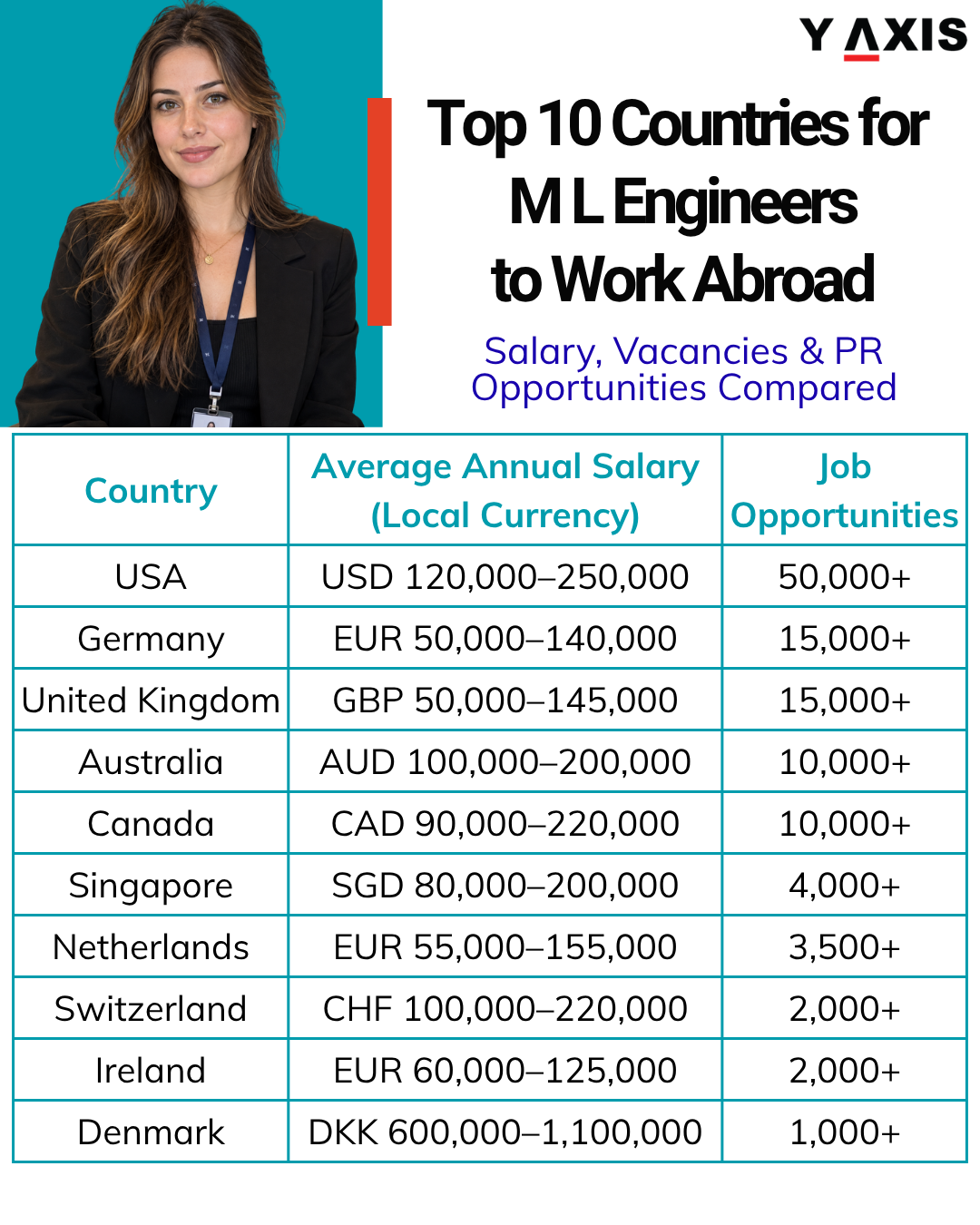
The top 10 countries for Machine Learning (ML) Engineers to work abroad are the USA, Australia, Canada, Germany, the UK, Singapore, Switzerland, the Netherlands, Ireland and Denmark. These countries offer ML Engineer jobs, competitive salaries, established AI industries, skilled-worker visa options and PR pathways. The global machine learning market is projected to reach USD 684.4 billion by 2033, growing at a 26.0% CAGR. The World Economic Forum lists AI and Machine Learning Specialists among the fastest-growing jobs through 2030.
Growing adoption of generative AI, predictive analytics, computer vision and natural language processing is increasing demand for ML Engineers across technology, finance, healthcare, automotive and manufacturing, expanding opportunities to build careers and pursue long-term residence abroad.
*Want to work abroad? Sign up with Y-Axis Resume Marketing Services to find right job faster.
Why Many Countries Are Hiring More Machine Learning Engineers?
Machine Learning Engineers are in high demand worldwide because businesses are rapidly adopting AI. According to the World Economic Forum (WEF), AI and information-processing technologies are projected to create 11 million jobs by 2030. Growing use of generative AI, predictive analytics and automation, along with government AI investments and a shortage of ML Engineers, is increasing demand across major global markets.
- AI product development: ML powers search, recommendations, chatbots and personalised platforms.
- Healthcare: ML supports medical imaging, diagnosis and drug discovery.
- Fintech: Banks use ML for fraud detection, credit scoring and risk assessment.
- Autonomous systems: ML enables perception and decision-making in vehicles and robots.
- Cybersecurity: ML helps detect threats, unusual activity and security risks.
- AI research: Research centres need ML Engineers to develop and improve advanced models.
How to Choose the Best Country for Machine Learning Engineer Jobs Abroad?
The best country for ML Engineer jobs depends on salary, job demand, work visa options, cost of living and PR pathways. Compare these factors with your experience, skills, preferred industry and long-term relocation plans to choose the country that offers the right balance of career opportunities and immigration options.
- Job demand: Check current ML Engineer vacancies and projected hiring.
- Salary: Compare salaries against taxes and living costs.
- Work visa: Check eligibility, salary thresholds and employer sponsorship requirements.
- PR pathway: Review permanent residence or long-term residency options.
- AI ecosystem: Consider the strength of the country’s AI and technology sector.
- Career growth: Look for opportunities to work with established AI companies and emerging technologies.
Top 10 Countries for Machine Learning Engineers to Work Abroad
The USA, Australia, Germany, Canada and the UK are among the leading destinations for Machine Learning Engineers, with strong job demand, competitive salaries and growing AI ecosystems. ML Engineers earn more than AUD 100,000 annually, while demand for generative AI, large language models, computer vision, recommendation systems, deep learning and MLOps continues to grow. These countries offer opportunities to work on advanced AI projects, gain international experience and build long-term careers in global technology markets.
| Country | Average Annual Salary (Local Currency) |
Estimated Machine Learning Engineer Job Opportunities |
|---|---|---|
| USA | USD 120,000–250,000 | 50,000+ |
| Australia | AUD 100,000–200,000 | 10,000+ |
| Germany | EUR 50,000–140,000 | 15,000+ |
| Canada | CAD 90,000–220,000 | 10,000+ |
| Switzerland | CHF 100,000–220,000 | 2,000+ |
| United Kingdom | GBP 50,000–145,000 | 15,000+ |
| Singapore | SGD 80,000–200,000 | 4,000+ |
| Netherlands | EUR 55,000–155,000 | 3,500+ |
| Ireland | EUR 60,000–125,000 | 2,000+ |
| Denmark | DKK 600,000–1,100,000 | 1,000+ |
*Want to work abroad? Sign up with Y-Axis Resume Marketing Services to find right job faster.
Best Countries for Machine Learning Engineers to Work and Settle Abroad
Canada, Australia, Germany, the UK and Ireland are among the best countries for Machine Learning Engineers seeking jobs abroad and a pathway to permanent residence. These countries offer strong ML job demand, competitive salaries, skilled-worker visa options and clear settlement pathways, making them attractive destinations for building a long-term career in AI and machine learning.
Machine Learning Engineer Jobs in the USA
The USA is a top destination for Machine Learning Engineers seeking advanced AI projects and strong career growth. Demand is rising for skills in Generative AI, large language models, computer vision, autonomous systems and MLOps, with opportunities across technology, finance, healthcare and automotive companies. The US Bureau of Labor Statistics projects 35% growth in Data Scientist employment by 2034, adding about 95,400 jobs, supporting continued growth in AI and ML-related roles. International ML Engineers can explore the H-1B employer-sponsored visa, while employment-based immigration routes can lead to permanent residence. With leading AI companies, research institutions and technology hubs, the USA offers excellent opportunities to build an international ML career.
| Factor | Details |
|---|---|
| Machine Learning Engineer Job Market & Job Vacancies for the Next Decade | The USA is expected to offer more than 50,000 Machine Learning Engineer job opportunities over the next decade, with rising demand for Generative AI, LLMs, computer vision, predictive analytics, autonomous systems and MLOps. |
| Investment in Artificial Intelligence & AI Research | The USA is expected to attract nearly USD 600 billion in AI investment, supporting ML research, LLM development, Generative AI, AI infrastructure and large-scale machine learning applications. |
| Top Companies Hiring Machine Learning Engineers | Google, Microsoft, Amazon, Meta, OpenAI, Anthropic and IBM are major employers, with ML Engineer roles focused on LLM development, computer vision, recommendation systems, AI infrastructure and MLOps. |
| Top Cities for Machine Learning Engineer Jobs | San Francisco Bay Area, Seattle, New York City, Boston, Austin and Washington, DC are leading locations for ML Engineer jobs across technology, finance, healthcare, automotive and AI research. |
| In-Demand Roles & Skills | Popular roles include Machine Learning Engineer, AI Engineer, Applied ML Engineer, ML Architect and MLOps Engineer. Employers commonly look for Python, PyTorch, TensorFlow, deep learning, NLP, computer vision, LLMs, model deployment and MLOps. |
| Work Visa Options | The H-1B visa is the main employer-sponsored route for Machine Learning Engineers. Candidates with exceptional achievements in AI research, publications, patents or industry contributions may also consider the O-1A visa. |
| Fast-Track Hiring Options | USCIS Premium Processing can speed up processing for eligible immigration petitions. ML Engineers with significant research, patents, publications or AI industry achievements may also qualify for the O-1A route. |
| PR / Long-Term Residence Opportunities | Green Card pathways include EB-2, EB-2 National Interest Waiver, EB-3 and EB-1A. The most suitable route depends on education, experience, employer sponsorship and professional or research achievements. |
| Eligibility for Dependents | H-1B workers can generally bring their spouse and unmarried children under 21 on H-4 status. O-1A workers can bring their spouse and unmarried children under 21 on O-3 status. |
| Benefits for Family Members | H-4 children can study in the USA, while eligible H-4 spouses may apply for employment authorization. O-3 dependents can study but generally cannot work. |
Machine Learning Engineer Jobs in Australia
Australia is a strong choice for Machine Learning Engineers looking to work in AI and build a long-term career abroad. Demand is growing for ML skills in Generative AI, large language models, computer vision, predictive modelling and MLOps across technology, finance, healthcare and manufacturing. Jobs and Skills Australia lists Machine Learning Engineer as an emerging role due to growing demand for specialised AI skills. Australian employment is projected to reach 16.6 million by May 2035, adding nearly 2 million jobs. The Skills in Demand visa (subclass 482), subclass 186, and skilled migration programs such as 189, 190 and 491 provide pathways to work and permanent residence, making Australia an attractive destination for ML Engineers.
| Factor | Details |
|---|---|
| Machine Learning Engineer Job Market & Job Vacancies for the Next Decade | Australia is expected to offer more than 10,000 Machine Learning Engineer job opportunities over the next decade, with demand for Generative AI, LLMs, computer vision, predictive analytics, recommendation systems and MLOps. |
| Investment in Artificial Intelligence & AI Research | Australia is strengthening AI investment through more than AUD 1 billion in critical-technology funding, alongside dedicated support for AI research, computing infrastructure, AI adoption and workforce development. |
| Top Companies Hiring Machine Learning Engineers | Canva, Atlassian, Telstra, Commonwealth Bank, CSIRO, Microsoft and Google hire ML Engineers for AI models, LLMs, computer vision, predictive systems and AI-powered products. |
| Top Cities for Machine Learning Engineer Jobs | Sydney, Melbourne, Brisbane, Canberra and Adelaide are major ML job centres, with roles across technology, finance, healthcare, manufacturing, software and AI research. |
| In-Demand Roles & Skills | Common roles include Machine Learning Engineer, Applied ML Engineer, AI Engineer, ML Architect and MLOps Engineer. Employers commonly seek Python, PyTorch, TensorFlow, deep learning, NLP, computer vision, LLMs, cloud and MLOps skills. |
| Work Visa Options | The Skills in Demand visa (subclass 482) allows Australian employers to sponsor skilled workers for nominated occupations. ML Engineers must meet the relevant occupation, skills, experience, English and visa requirements. |
| Fast-Track Hiring Options | ML Engineers with exceptional achievements in AI or technology may consider the National Innovation visa (subclass 858), while employer sponsorship through the subclass 482 provides another route to work in Australia. |
| PR / Long-Term Residence Opportunities | ML Engineers can pursue PR through subclass 189, 190 or 186. Those on the subclass 491 can progress to subclass 191 after meeting the required conditions. |
| Eligibility for Dependents | ML Engineers can generally include their partner and dependent children in the relevant Australian visa application, subject to family-unit and visa requirements. |
| Benefits for Family Members | Partners may be able to work in Australia under their visa conditions, while children can attend Australian schools. Medicare access depends on the visa and applicable healthcare arrangements. |
*Planning to Work in Australia? Let Y-Axis guide you through every step of the process.
Machine Learning Engineer Jobs in Germany
Germany offers strong opportunities for Machine Learning Engineers in automotive AI, robotics, smart manufacturing and industrial automation. ML Engineers work on computer vision, autonomous driving, predictive maintenance, Generative AI and intelligent production systems. The working-age population is projected to decline by 3.2 million by 2035, increasing demand for skilled technology workers. Germany also plans to quadruple its high-performance computing and AI capacity by 2030, supporting advanced AI development. International ML Engineers can use the EU Blue Card, while the Opportunity Card allows skilled workers to enter Germany and look for jobs. With a strong industrial AI sector, Germany offers excellent job opportunities for building a specialised ML career in Europe.
| Factor | Details |
|---|---|
| Machine Learning Engineer Job Market & Job Vacancies for the Next Decade | Germany is expected to offer more than 15,000 Machine Learning Engineer job opportunities over the next decade, with growing demand for Generative AI, LLMs, computer vision, autonomous driving, predictive modelling and industrial machine learning. |
| Investment in Artificial Intelligence & AI Research | Germany is investing more than EUR 5 billion in AI research and development, supporting ML research, Generative AI, LLM development, AI computing and machine learning applications in industry. |
| Top Companies Hiring Machine Learning Engineers | SAP, Siemens, Bosch, BMW, Deutsche Telekom, Volkswagen and Aleph Alpha hire ML Engineers to build AI models, computer vision systems, autonomous technologies, predictive models and industrial AI solutions. |
| Top Cities for Machine Learning Engineer Jobs | Berlin, Munich, Hamburg, Frankfurt and Stuttgart are key locations for ML Engineers, with jobs in Generative AI, automotive AI, enterprise software, financial technology, manufacturing and AI research. |
| In-Demand Roles & Skills | Common roles include Machine Learning Engineer, Applied ML Engineer, AI Engineer, ML Architect and MLOps Engineer. Key skills include Python, PyTorch, TensorFlow, deep learning, NLP, computer vision, LLMs, model deployment and MLOps. |
| Work Visa Options | The EU Blue Card provides a work and residence route for ML Engineers with a recognised qualification, a German employment contract and the required salary. The Skilled Worker visa provides another route for technology roles. |
| Fast-Track Hiring Options | The Accelerated Skilled Worker Procedure allows German employers to start the residence process with the foreigners authority before the ML Engineer submits the visa application, helping reduce processing time. |
| PR / Long-Term Residence Opportunities | EU Blue Card holders can qualify for a settlement permit after 27 months, or after 21 months with B1-level German. Skilled-worker residence permits can also lead to permanent residence. |
| Eligibility for Dependents | EU Blue Card holders can generally bring their spouse and minor children through family reunification. Family members receive residence permits to live in Germany. |
| Benefits for Family Members | Spouses can generally work in Germany without a separate work permit, while children can attend German schools. Family reunification allows the family to live together in Germany. |
*Want to Work in Germany? Let Y-Axis guide you through every step of the process.
Machine Learning Engineer Jobs in Canada
Canada is one of the best countries for Machine Learning Engineers seeking high-demand AI jobs and a pathway to permanent residence. ML Engineers work on Generative AI, large language models, computer vision, predictive analytics and recommendation systems across technology, finance, healthcare, automotive and e-commerce. Canada’s AI strategy targets up to 250,000 new jobs through AI adoption by 2031, supporting long-term demand for ML skills. The Global Talent Stream provides a work permit route for specialised technology roles, while Express Entry and Provincial Nominee Programs (PNPs) offer pathways to permanent residence. Growing ML demand, advanced AI projects and immigration options make Canada an attractive choice for building a long-term Machine Learning Engineering career.
| Factor | Details |
|---|---|
| Machine Learning Engineer Job Market & Job Vacancies for the Next Decade | Canada is expected to offer more than 10,000 Machine Learning Engineer job opportunities over the next decade, with demand for Generative AI, LLMs, computer vision, predictive modelling, recommendation systems and MLOps across technology, finance, healthcare and e-commerce. |
| Investment in Artificial Intelligence & AI Research | Canada has committed CAD 2.4 billion to AI, supporting AI research, computing infrastructure, startups and the development and deployment of advanced ML models. |
| Top Companies Hiring Machine Learning Engineers | Cohere, Google, Microsoft, Amazon, NVIDIA, RBC and Shopify hire ML Engineers for LLM development, Generative AI, recommendation systems, computer vision, predictive analytics and ML infrastructure. |
| Top Cities for Machine Learning Engineer Jobs | Toronto, Montreal, Vancouver, Ottawa, Edmonton and Waterloo are major ML job hubs, with opportunities in AI product development, fintech, healthcare, autonomous systems and e-commerce. |
| In-Demand Roles & Skills | Employers hire for Machine Learning Engineer, Applied ML Engineer, AI Engineer, MLOps Engineer and ML Architect roles. Key skills include Python, PyTorch, TensorFlow, deep learning, NLP, computer vision, LLMs, cloud and MLOps. |
| Work Visa Options | ML Engineers with a Canadian job offer can apply for an employer-specific work permit. Depending on the position and employer, an LMIA may be required. |
| Fast-Track Hiring Options | The Global Talent Stream provides faster processing for certain specialised technology positions, making it a useful route for highly skilled ML and AI Engineers. |
| PR / Long-Term Residence Opportunities | ML Engineers can pursue PR through Express Entry, including the Federal Skilled Worker Program and Canadian Experience Class. Provincial Nominee Programs (PNPs) provide additional routes. |
| Eligibility for Dependents | ML Engineers applying for Canadian PR can include their spouse or common-law partner and dependent children, subject to immigration requirements. |
| Benefits for Family Members | A spouse or common-law partner may qualify for an open work permit, while dependent children may study in Canada with the required authorization. |
*Want to work in Canada? Get expert guidance from Y-Axis professionals.
Machine Learning Engineer Jobs in the UK
The UK is a high-value career destination for Machine Learning Engineers, offering advanced AI projects, strong career growth and a pathway to permanent residence. ML Engineers work on Generative AI, large language models, computer vision, recommendation systems, predictive analytics and MLOps across technology, finance, healthcare, automotive and e-commerce. UK government projections indicate that AI-related employment could reach 3.9 million jobs by 2035, supporting continued demand for specialised AI skills. The Skilled Worker visa provides a route to work in the UK and can lead to Indefinite Leave to Remain after five years. ML Engineers can gain international experience, specialise in high-demand AI technologies and progress into senior roles while building a long-term career in the UK.
| Factor | Details |
|---|---|
| Machine Learning Engineer Job Market & Job Vacancies for the Next Decade | The UK is expected to offer more than 15,000 Machine Learning Engineer job opportunities over the next decade, with hiring focused on Generative AI, LLMs, computer vision, predictive analytics, recommendation systems and MLOps. |
| Investment in Artificial Intelligence & AI Research | More than £1 billion is being invested in UK AI research and development, strengthening AI computing, foundation models, Generative AI, machine learning research and the adoption of AI across industries. |
| Top Companies & Organisations Hiring Machine Learning Engineers | Google DeepMind, Microsoft, Amazon, Meta, Anthropic, OpenAI and BT recruit ML Engineers for LLM development, Generative AI, computer vision, model training, AI infrastructure and MLOps. |
| Top Cities for Machine Learning Engineer Jobs | London, Cambridge, Oxford, Manchester, Edinburgh and Bristol have strong demand for ML Engineers, particularly in technology, financial services, healthcare, automotive, enterprise software and AI research. |
| In-Demand Roles & Skills | ML Engineers can find roles such as Machine Learning Engineer, Applied ML Engineer, AI Engineer, ML Architect and MLOps Engineer. Employers commonly seek Python, PyTorch, TensorFlow, deep learning, NLP, computer vision, LLMs, cloud and MLOps skills. |
| Work Visa Options | The Skilled Worker visa provides a route for ML Engineers with a UK job offer and sponsorship from an approved employer. The role and salary must meet the applicable visa requirements. |
| Fast-Track Hiring Options | Priority visa service can reduce processing time for applications that meet the service requirements. ML Engineers with recognised AI research or technology achievements can also use the Global Talent visa without employer sponsorship. |
| PR / Long-Term Residence Opportunities | ML Engineers on the Skilled Worker route can apply for Indefinite Leave to Remain after five years of qualifying residence. Global Talent holders can qualify for settlement after three or five years, depending on their route. |
| Eligibility for Dependents | Skilled Worker and Global Talent visa holders can generally bring their partner and dependent children to the UK under the dependant route, subject to the relevant visa requirements. |
| Benefits for Family Members | Dependant partners can generally work in the UK, while dependent children can attend UK schools. Family members can also build toward settlement by meeting the applicable residence requirements. |
Machine Learning Engineer Jobs in Switzerland
Machine Learning Engineer jobs in Switzerland cover Generative AI, computer vision, predictive analytics, AI infrastructure and MLOps, with demand across finance, healthcare, pharmaceuticals and technology. ML Engineers work on fraud detection, financial modelling, medical AI, drug discovery and intelligent automation. A shortage of around 40,000 IT specialists is expected by 2030, supporting demand for specialised ML skills. Non-EU/EFTA ML Engineers generally need a Swiss work and residence permit. A C settlement permit is generally available after 10 years, with earlier routes for some nationalities. Switzerland combines high-value ML projects, strong salaries and long-term settlement options for experienced Machine Learning Engineers.
| Factor | Details |
|---|---|
| Machine Learning Engineer Job Market & Job Vacancies for the Next Decade | Switzerland is expected to offer more than 2,000 Machine Learning Engineer job opportunities over the next decade, with growing demand for Generative AI, LLMs, computer vision, predictive analytics, AI infrastructure and MLOps. |
| Investment in Artificial Intelligence & AI Research | More than CHF 680 million has been committed to AI research and computing, strengthening high-performance computing, ML research, Generative AI and large-scale AI applications. |
| Top Companies & Organisations Hiring Machine Learning Engineers | Google, IBM, Microsoft, UBS, Roche, Novartis and Swisscom hire ML Engineers for AI model development, LLMs, computer vision, financial modelling, healthcare AI and intelligent automation. |
| Top Cities for Machine Learning Engineer Jobs | Zurich, Geneva, Lausanne, Basel and Bern are important ML and research centres, with roles in financial technology, healthcare AI, pharmaceuticals, enterprise software, Generative AI and AI research. |
| In-Demand Roles & Skills | ML careers include Machine Learning Engineer, Applied ML Engineer, AI Engineer, ML Architect and MLOps Engineer. Employers seek Python, PyTorch, TensorFlow, deep learning, NLP, computer vision, LLMs, model deployment and MLOps skills. |
| Work Visa Options | ML Engineers from outside the EU/EFTA generally need an L or B residence permit for employment. The L permit covers short-term employment, while the B permit supports longer-term residence. |
| Fast-Track Hiring Options | Swiss employers submit work-permit applications to the cantonal authorities. Highly qualified ML Engineers can be recruited under Switzerland’s rules for non-EU/EFTA specialists, subject to quotas and labour-market requirements. |
| PR / Long-Term Residence Opportunities | ML Engineers can generally apply for a C settlement permit after 10 years of residence. Some nationalities can qualify earlier under specific residence and integration rules. |
| Eligibility for Dependents | ML Engineers with a Swiss residence permit can generally apply for family reunification for their spouse or registered partner and unmarried children under 18, subject to the residence and documentation requirements. |
| Benefits for Family Members | Spouses and registered partners can generally work in Switzerland under their residence status, while dependent children can live and attend school in Switzerland. |
Machine Learning Engineer Jobs in Singapore
Singapore has high-demand Machine Learning Engineer jobs, advanced AI projects and strong career growth across technology, finance, healthcare, manufacturing and logistics. ML Engineers work on Generative AI, large language models, computer vision, recommendation systems, predictive analytics and MLOps. Singapore aims to build an AI workforce of around 15,000 workers by 2028, while AI adoption could generate up to SGD 198.3 billion in economic benefits by 2030, supporting continued demand for ML skills. The Employment Pass provides a work route for ML Engineers with a job offer and pathway to long-term residence. ML Engineers can work on large-scale AI applications, develop specialised ML expertise and progress into advanced engineering roles in Singapore.
| Factor | Details |
|---|---|
| Machine Learning Engineer Job Market & Job Vacancies for the Next Decade | Singapore is expected to offer more than 4,000 Machine Learning Engineer job opportunities over the next decade, with hiring driven by Generative AI, LLMs, computer vision, predictive analytics, recommendation systems and MLOps. |
| Investment in Artificial Intelligence & AI Research | Singapore’s RIE 2030 plan allocates S$37 billion for research and innovation, supporting AI research, computing infrastructure, machine learning, Generative AI and advanced digital technologies. |
| Top Companies Hiring Machine Learning Engineers | Google, Microsoft, Amazon, IBM, Grab, Sea Group and DBS hire ML Engineers for LLM development, Generative AI, computer vision, predictive modelling, AI infrastructure and automation. |
| Top Cities for Machine Learning Engineer Jobs | Singapore is the country’s main AI and technology hub, with ML roles around one-north, Fusionopolis and the Central Business District, particularly in technology, finance, research and AI development. |
| In-Demand Roles & Skills | ML Engineers are hired as Machine Learning Engineers, Applied ML Engineers, AI Engineers, ML Architects and MLOps Engineers. Key skills include Python, PyTorch, TensorFlow, deep learning, NLP, computer vision, LLMs, cloud and MLOps. |
| Work Visa Options | The Employment Pass (EP) is the main work-pass route for professional ML Engineer roles. The S Pass is another option for certain technical positions, with separate salary and quota requirements. |
| Fast-Track Hiring Options | The ONE Pass provides greater flexibility for high-earning professionals and people with strong achievements in technology, research or innovation. |
| PR / Long-Term Residence Opportunities | Employment Pass and S Pass holders can apply for Singapore Permanent Residence. Applications consider factors such as qualifications, salary, employment history, length of residence and contributions to Singapore. |
| Eligibility for Dependents | EP holders who meet the required salary threshold can generally bring their legally married spouse and unmarried children under 21 on Dependant’s Passes. |
| Benefits for Family Members | Dependant’s Pass holders can live in Singapore with the main pass holder. Spouses need the required work authorisation to work, while children can attend Singapore schools subject to admission requirements. |
Machine Learning Engineer Jobs in the Netherlands
Machine Learning Engineer jobs in the Netherlands combine advanced AI work with strong opportunities for technical career growth. ML Engineers can build Generative AI models, large language models, computer vision systems, predictive analytics and MLOps solutions across technology, finance, healthcare, logistics and semiconductors. Dutch ICT employment is projected to grow by around 20,000 jobs through 2028, supporting continued demand for specialised AI and digital skills. The Highly Skilled Migrant programme provides a work route for international ML Engineers, while permanent residence can be pursued after five years of continuous legal residence. Access to advanced technology companies, semiconductor projects and applied AI research allows ML Engineers to develop specialised expertise and move into senior engineering positions.
| Factor | Details |
|---|---|
| Machine Learning Engineer Job Market & Job Vacancies for the Next Decade | The Netherlands is expected to offer more than 3,500 Machine Learning Engineer job opportunities over the next decade, particularly in Generative AI, LLMs, computer vision, predictive analytics, NLP and MLOps. |
| Investment in Artificial Intelligence & AI Research | More than EUR 2 billion is being invested in AI and digital innovation in the Netherlands, supporting AI research, computing infrastructure, machine learning, Generative AI and advanced AI applications. |
| Top Companies Hiring Machine Learning Engineers | ASML, Philips, ING, Booking.com, Adyen, Shell and Microsoft hire ML Engineers to develop LLMs, computer vision systems, predictive models, AI infrastructure, automation and intelligent products. |
| Top Cities for Machine Learning Engineer Jobs | Amsterdam, Eindhoven, Utrecht, Rotterdam, Delft and The Hague are key locations for ML careers, with roles spanning AI, fintech, semiconductor technology, healthcare, enterprise software and AI research. |
| In-Demand Roles & Skills | ML careers include Machine Learning Engineer, Applied ML Engineer, AI Engineer, ML Architect and MLOps Engineer. Employers look for Python, PyTorch, TensorFlow, deep learning, NLP, computer vision, LLMs, cloud platforms and MLOps. |
| Work Visa Options | The Highly Skilled Migrant permit is a main route for ML Engineers hired by an IND-recognised sponsor. The EU Blue Card provides another option for candidates meeting its salary, employment and qualification requirements. |
| Fast-Track Hiring Options | IND-recognised employers can submit Highly Skilled Migrant applications directly to the IND, making the residence-permit process more straightforward for ML Engineers recruited from abroad. |
| PR / Long-Term Residence Opportunities | ML Engineers can generally apply for permanent residence after five years of lawful residence, provided they meet the residence, income, permit and civic integration requirements. |
| Eligibility for Dependents | ML Engineers with a Dutch residence permit can generally bring their spouse, registered partner and dependent children through family reunification. |
| Benefits for Family Members | A Highly Skilled Migrant’s spouse or partner can generally work without a separate work permit, while dependent children can live and attend school in the Netherlands. |
Machine Learning Engineer Jobs in Ireland
Ireland provides Machine Learning Engineers with access to global technology companies, advanced AI projects and strong career progression. ML Engineers work on Generative AI, natural language processing, computer vision, predictive analytics and MLOps across technology, finance, healthcare and e-commerce. Ireland’s digital specialist workforce is projected to reach around 215,400 by 2030, while the country could face an annual shortage of 5,500 digital specialists, supporting demand for specialised ML skills. The Critical Skills Employment Permit provides a direct work route, while Long Term Residency can be applied for after 60 months of qualifying residence. Global AI projects, specialised ML roles and long-term residence options make Ireland a strong choice for building and advancing a Machine Learning Engineering career.
| Factor | Details |
|---|---|
| Machine Learning Engineer Job Market & Job Vacancies for the Next Decade | Ireland is expected to offer more than 2,000 Machine Learning Engineer job opportunities over the next decade. Hiring is increasingly centred on Generative AI, LLMs, computer vision, predictive analytics, NLP and MLOps. |
| Investment in Artificial Intelligence & AI Research | More than €1 billion is being invested in AI and digital transformation in Ireland, strengthening AI research, computing infrastructure, machine learning development, Generative AI and business adoption. |
| Top Companies Hiring Machine Learning Engineers | Google, Microsoft, Meta, IBM, Accenture, HubSpot and Salesforce are among the major employers, with ML Engineers working on LLMs, Generative AI, model development, AI infrastructure and intelligent automation. |
| Top Cities for Machine Learning Engineer Jobs | Dublin leads Ireland’s technology sector, while Cork, Galway, Limerick and Waterford also have ML and AI roles across financial services, healthcare, cloud computing, enterprise software and AI research. |
| In-Demand Roles & Skills | Employers recruit for Machine Learning Engineer, Applied ML Engineer, AI Engineer, ML Architect and MLOps Engineer positions. Strong demand exists for Python, PyTorch, TensorFlow, deep learning, NLP, computer vision, LLMs, cloud platforms and MLOps. |
| Work Visa Options | The Critical Skills Employment Permit provides a direct work route for Machine Learning Engineers when the position and salary meet its requirements. The General Employment Permit provides another route for jobs meeting its occupation and salary conditions. |
| Fast-Track Hiring Options | Machine Learning Engineers hired through the Critical Skills Employment Permit do not require a Labour Market Needs Test, allowing employers to proceed without completing this recruitment test. |
| PR / Long-Term Residence Opportunities | After two years on a Critical Skills Employment Permit, ML Engineers can generally move to Stamp 4, allowing them to work without an employment permit. Long-Term Residency can be available after 60 months of qualifying residence. |
| Eligibility for Dependents | Critical Skills Employment Permit holders can generally bring their spouse, partner and dependent children through the family reunification route, subject to Ireland’s immigration rules. |
| Benefits for Family Members | Spouses and partners can generally work without a separate employment permit, while dependent children can attend schools in Ireland under the applicable immigration conditions. |
Machine Learning Engineer Jobs in Denmark
Denmark has growing demand for Machine Learning Engineers in AI, robotics, automation and advanced digital technologies, with roles across technology, healthcare, manufacturing, finance and logistics. ML Engineers work on Generative AI, computer vision, predictive analytics, natural language processing and intelligent automation. Nearly eight out of 10 Danish companies use AI, supporting continued demand for specialised ML skills. Denmark is also preparing for long-term AI growth, with DKK 5 billion in proposed public co-financing by 2030 for an AI gigafactory. The Positive List for higher education provides a work-permit route for listed shortage occupations. Growing AI adoption and investment give ML Engineers strong scope to work on advanced projects and progress their careers in Denmark.
| Factor | Details |
|---|---|
| Machine Learning Engineer Job Market & Job Vacancies for the Next Decade | Denmark is expected to offer more than 1,000 Machine Learning Engineer jobs over the next decade, particularly in Generative AI, LLMs, computer vision, predictive modelling, NLP, robotics and MLOps. |
| Investment in Artificial Intelligence & AI Research | Denmark has allocated DKK 60 million for AI research in 2027. Danish Industry has also proposed DKK 5 billion in public co-financing by 2030 for an AI gigafactory, expanding computing capacity for large-scale ML workloads. |
| Top Companies Hiring Machine Learning Engineers | Novo Nordisk, LEGO, Danfoss, Maersk, Microsoft and Universal Robots hire ML Engineers for predictive modelling, computer vision, Generative AI, robotics and automation. |
| Top Cities for Machine Learning Engineer Jobs | Copenhagen, Aarhus, Odense and Aalborg have ML roles across AI research, pharmaceuticals, robotics, manufacturing, fintech and software. |
| In-Demand Roles & Skills | Roles include Machine Learning Engineer, Applied ML Engineer, AI Engineer, MLOps Engineer and ML Architect. Key skills include Python, PyTorch, TensorFlow, deep learning, NLP, computer vision, LLMs and MLOps. |
| Work Visa Options | The Positive List for People with a Higher Education, Pay Limit Scheme and Fast-Track Scheme provide routes to work in Denmark, depending on the job and salary. |
| Fast-Track Hiring Options | The Fast-Track Scheme allows SIRI-certified Danish companies to recruit international ML Engineers through an expedited work and residence process. |
| PR / Long-Term Residence Opportunities | Permanent residence is generally available after 8 years of legal residence, or 4 years when all additional requirements are met. |
| Eligibility for Dependents | ML Engineers with a Danish work and residence permit can generally bring their spouse or partner and children through family reunification. |
| Benefits for Family Members | Family members can live in Denmark; spouses or partners can generally work, and children can attend Danish schools under their residence conditions. |
Job Outlook for Machine Learning Engineers over the Next Decade
The job outlook for Machine Learning Engineers is very positive over the next decade, driven by the rapid adoption of Generative AI, large language models, computer vision, predictive analytics and automated systems. The global machine learning market is projected to reach USD 684.4 billion by 2033, growing at a 26.0% CAGR, while the World Economic Forum lists AI and Machine Learning Specialists among the fastest-growing jobs through 2030.
Demand is increasing across technology, finance, healthcare, automotive, manufacturing, e-commerce and logistics as businesses develop and deploy AI-powered products and systems. ML Engineers with skills in LLMs, deep learning, NLP, computer vision, Python, cloud computing and MLOps are well positioned for growing demand as AI adoption expands globally.
*Want to work abroad? Sign up with Y-Axis Resume Marketing Services to find right job faster.
FAQs
Which country is best for Machine Learning Engineers to work abroad?
The USA, Australia, Germany, Canada and the UK are among the top countries for Machine Learning Engineers. They offer strong demand for ML skills, competitive salaries, established AI industries and work visa pathways. Australia, Canada, Germany and the UK also provide routes that can lead to permanent residence.
Which country pays the highest salary for Machine Learning Engineers?
The USA generally offers the highest salaries among the countries compared, with Machine Learning Engineers earning around USD 120,000–250,000 per year. Switzerland also offers high salaries, typically around CHF 100,000–220,000 annually, depending on experience, location and employer.
What is the average salary of a Machine Learning Engineer abroad?
Machine Learning Engineer salaries vary significantly by country, experience and specialisation. In the countries covered in this article, annual salaries range from around DKK 600,000 in Denmark to USD 250,000 in the USA at the upper end. LLMs, deep learning, computer vision and MLOps skills can command higher salaries.
Which countries have the highest demand for Machine Learning Engineers?
The USA, Australia, Germany, Canada and the UK have particularly strong demand for Machine Learning Engineers. Hiring is concentrated in Generative AI, LLMs, computer vision, predictive analytics, autonomous systems and MLOps, with jobs across technology, finance, healthcare, automotive and manufacturing.
Which countries offer the most Machine Learning Engineer jobs?
The USA, UK, Germany, Canada and Australia have some of the largest Machine Learning Engineer job markets among the countries compared. Demand is particularly high for Generative AI, LLMs, deep learning, computer vision, predictive modelling and MLOps across technology, finance, healthcare, automotive and manufacturing.
Is Australia a good country for Machine Learning Engineers?
Yes. Australia offers Machine Learning Engineer roles in Generative AI, predictive modelling, computer vision, LLMs and MLOps across technology, finance, healthcare and manufacturing. Australia also has skilled migration routes including subclass 189, 190 and 491, along with employer-sponsored pathways such as subclass 482 and 186.
What is the salary of a Machine Learning Engineer in Australia?
Machine Learning Engineers in Australia typically earn around AUD 100,000–200,000 per year, depending on experience, technical specialisation, location and employer. Senior engineers with expertise in LLMs, deep learning, AI infrastructure or MLOps can command salaries towards the upper end of this range.
Are Machine Learning Engineer jobs in demand in Australia?
Yes. Jobs and Skills Australia identifies Machine Learning Engineer as an emerging occupation due to growing demand for specialised AI skills. Hiring is increasing in areas such as Generative AI, computer vision, predictive modelling, automation and MLOps.
Which country is best for Machine Learning Engineers to get PR?
Canada, Australia, Germany, the UK and Ireland offer established routes from employment to permanent residence or long-term settlement. The most suitable option depends on factors such as occupation, qualifications, salary, work experience, age and the specific immigration programme.
Can Machine Learning Engineers get PR abroad?
Yes. Machine Learning Engineers can qualify for permanent residence in countries such as Canada, Australia, Germany, the UK and Ireland through skilled migration, employer-sponsored or work-based immigration routes. The requirements vary by country and can include job offers, work experience, qualifications, salary and language proficiency.
Which countries offer PR pathways for Machine Learning Engineers?
Canada, Australia, Germany, the UK and Ireland provide established immigration pathways that can lead to permanent residence or long-term settlement. For example, Canada uses Express Entry and Provincial Nominee Programs, while Australia offers 189, 190 and 186 pathways.
What are the best countries for Machine Learning Engineers to settle abroad?
Canada, Australia, Germany, the UK and Ireland are strong options for ML Engineers seeking long-term settlement. These countries combine ML job demand, skilled-worker immigration routes and pathways to permanent residence, although the eligibility requirements differ for each programme.
How can I get a Machine Learning Engineer job abroad?
Build experience in Python, machine learning, deep learning, NLP, computer vision, LLMs and MLOps, then apply for ML Engineer roles with employers that sponsor international workers. A strong portfolio containing deployed ML models, LLM applications or production ML systems can strengthen your applications.
What qualifications do I need to work as a Machine Learning Engineer abroad?
Most Machine Learning Engineer roles require a bachelor’s or master’s degree in computer science, artificial intelligence, data science, mathematics, statistics or a related field, along with practical ML experience. Some employers place greater emphasis on demonstrated engineering skills and relevant industry experience.
What skills are required for Machine Learning Engineer jobs abroad?
Core skills include Python, machine learning algorithms, deep learning, SQL, PyTorch or TensorFlow, NLP, computer vision, LLMs, cloud platforms and MLOps. Experience with model deployment, APIs, Docker, Kubernetes and ML pipelines is also valuable for production-focused roles.
Do Machine Learning Engineers need a master’s degree to work abroad?
No. A master’s degree is not mandatory for every Machine Learning Engineer role. Many employers accept a bachelor’s degree combined with relevant experience and strong technical skills. A master’s degree can be particularly useful for advanced ML research, specialised AI roles and research-focused positions.
Which countries offer work visas for Machine Learning Engineers?
Countries including the USA, Australia, Canada, Germany, the UK, Switzerland, Singapore, the Netherlands, Ireland and Denmark have work-permit routes that can be used by ML Engineers, depending on the job, salary, qualifications and employer.
Which visa is best for Machine Learning Engineers to work abroad?
The best visa depends on the destination country and job offer. Examples include the H-1B in the USA, Skills in Demand visa in Australia, EU Blue Card in Germany, Global Talent Stream in Canada, Skilled Worker visa in the UK and Critical Skills Employment Permit in Ireland.
Can I get a Machine Learning Engineer job abroad without a master’s degree?
Yes. Many overseas ML Engineer jobs accept candidates with a bachelor’s degree plus relevant professional experience and strong technical skills. A strong portfolio in deep learning, LLMs, computer vision, model deployment or MLOps can also demonstrate practical expertise.
Which countries offer the best salary and PR opportunities for Machine Learning Engineers?
Australia, Canada, Germany, the UK and Ireland offer a useful combination of ML employment, competitive salaries and pathways to permanent residence. The USA and Switzerland generally offer higher salaries, but their permanent-residence routes can have different requirements and timelines.
Posted on October 09 2026
What is the Average Salary in Germany?
What is the Average Salary in Germany?
The average salary in Germany is approximately €5,370 gross per month, or €64,441 per year, for full-time employees, including special payments, according to the Federal Statistical Office (Destatis). The median gross annual salary is €54,066, and salaries in industries like finance and insurance, information and communication, and professional, scientific and technical services are above the national average. Take-home pay depends on tax and social security, while salaries vary by occupation, industry, experience and location.
Germany has strong demand for skilled workers in IT, healthcare, engineering, construction, skilled trades and education due to labour shortages. The country could face a shortage of up to 7 million workers by 2035. Cities like Berlin, Munich, Frankfurt, Hamburg and Stuttgart offer diverse job opportunities, making Germany attractive for career growth, stable employment and long-term settlement.
*Want to work in Germany? Let Y-Axis help you through the application process.
Average Salary for In-Demand Jobs in Germany
Germany has high demand for skilled workers in IT, healthcare, engineering, construction, skilled trades and education, with roles such as software developers, nurses, physicians, engineers, teachers and skilled trades workers among the most sought after. According to the Federal Employment Agency (BA), the median gross salary for full-time employees is €4,217 per month, while employees with academic qualifications have a median salary of €6,146 per month.
| Occupation | Average Annual Salary | Chances of Visa Sponsorship |
|---|---|---|
| IT & Software | €66,750 | High |
| Engineering | €75,000 | Very High |
| Healthcare | €53,000 | High |
| Nursing | €58,000 | Very High |
| Accounting & Finance | €59,250 | Moderate to High |
| Marketing & Sales | €57,250 | Moderate |
| Human Resources | €54,500 | Moderate |
| Logistics & Supply Chain | €49,750 | Moderate to High |
| Teaching | €60,250 | High |
| Construction & Skilled Trades | €54,000 | High |
Read More…
Most in-demand jobs in Germany for the next 10 years
Top 10 Highest-Paying Jobs in Germany
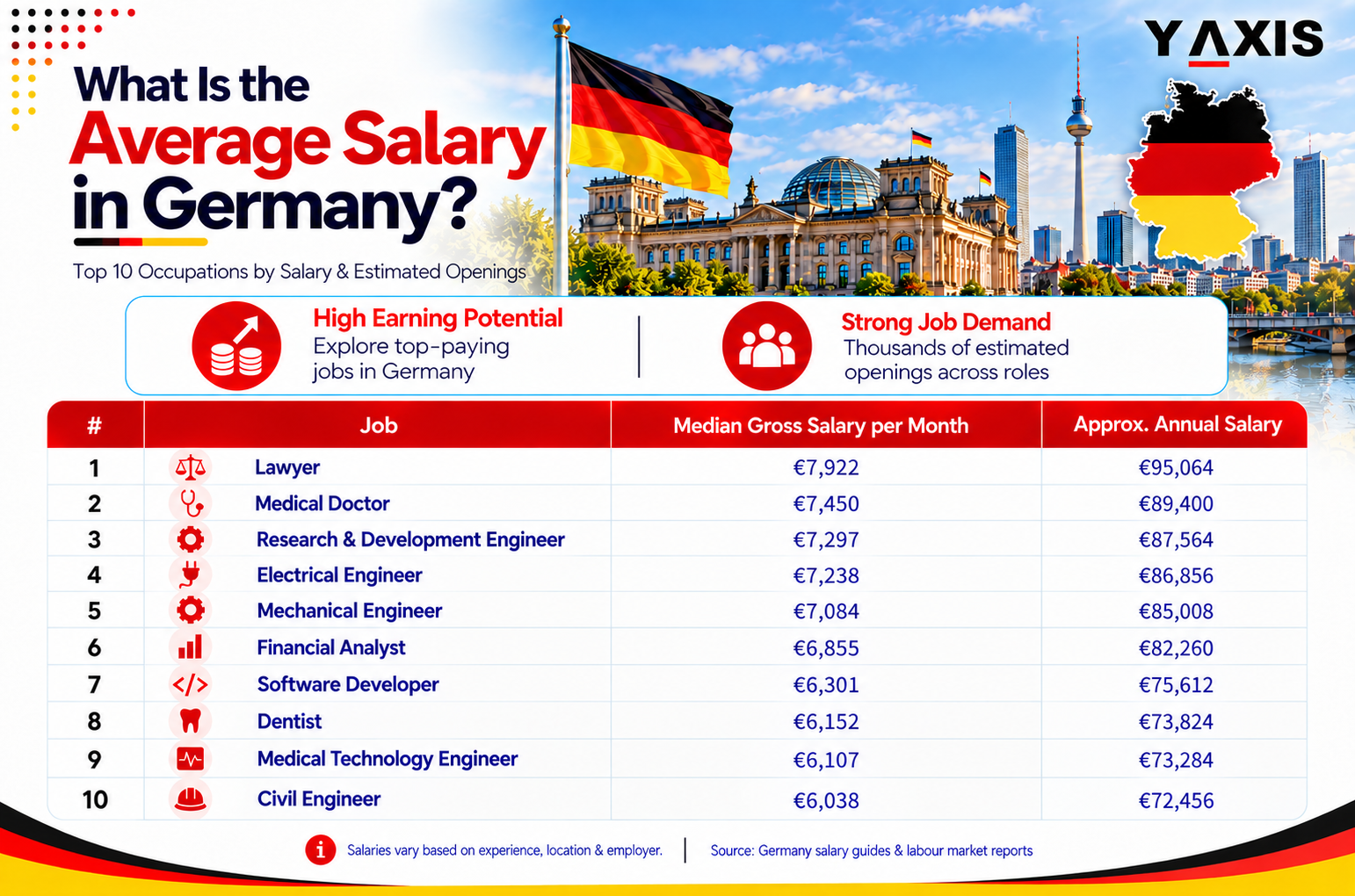
The highest-paying jobs in Germany include medical doctors, lawyers, engineers, financial analysts, software developers and senior management roles. Many of these occupations pay more than €50,000 annually, while senior roles and workers with specialised qualifications can earn significantly more. Medical, legal, engineering, IT and finance roles are among the strongest options for higher salaries in Germany.
| Job | Median Gross Salary per Month | Approx. Annual Salary |
|---|---|---|
| Lawyer | €7,922 | €95,064 |
| Medical Doctor | €7,450 | €89,400 |
| Research & Development Engineer | €7,297 | €87,564 |
| Electrical Engineer | €7,238 | €86,856 |
| Mechanical Engineer | €7,084 | €85,008 |
| Financial Analyst | €6,855 | €82,260 |
| Software Developer | €6,301 | €75,612 |
| Dentist | €6,152 | €73,824 |
| Medical Technology Engineer | €6,107 | €73,284 |
| Civil Engineer | €6,038 | €72,456 |
*Looking for jobs in Germany? Let Y-Axis guide you through application process.
Best Cities in Germany with Most Job Opportunities
Berlin, Munich, Frankfurt, Hamburg and Stuttgart are among the best cities in Germany for job opportunities, with major employment markets in technology, finance, engineering, automotive, healthcare, logistics and manufacturing.
- Berlin: Technology, IT, fintech, media and healthcare
- Munich: Automotive, engineering, IT, finance and insurance
- Frankfurt: Banking, finance, insurance, fintech and IT
- Hamburg: Logistics, shipping, aviation, media and IT
- Stuttgart: Automotive, engineering, manufacturing and technology
- Cologne: Media, telecommunications, insurance, healthcare and logistics
Also Read…
3 Million Jobs in Germany over the Next Decade
Germany vs Australia: Salary, Tax and Savings
The average gross salary in Germany is €58,212 annually, excluding special payments, while Australia’s average full-time earnings are approximately AUD 108,000 annually. Germany and Australia both have well-paid jobs in IT, engineering, healthcare, finance and skilled trades, but income tax, social security contributions, housing and daily expenses affect take-home pay and savings.
| Factor | Germany | Australia |
|---|---|---|
| Gross Monthly Salary | €4,800 | AUD 9,000 |
| Gross Annual Salary | €57,600 | AUD 108,000 |
| Estimated Monthly Tax & Contributions | €1,750 (36%) | AUD 2,100 (23%) |
| Estimated Monthly Take-Home Pay | €3,050 (64%) | AUD 6,900 (77%) |
| Estimated Monthly Living Costs | €1,800 | AUD 4,500 |
| Estimated Monthly Savings | €1,250 | AUD 2,400 |
| Estimated Annual Savings | €15,000 | AUD 28,800 |
Note: Figures are estimates and may vary by income, location, and individual circumstances.
Cost of Living in Germany
The cost of living in Germany is around €1,300–€2,400 per month for a single person, including rent, utilities, groceries and transport. Munich, Frankfurt, Berlin and Hamburg generally have higher housing costs, while Leipzig, Dresden and Essen are more affordable.
| Expense | Estimated Monthly Cost |
|---|---|
| 1-Bedroom Apartment | €800–€1,500 |
| Utilities & Internet | €200–€350 |
| Groceries | €250–€400 |
| Public Transport | €58–€100 |
| Mobile Phone | €15–€30 |
| Total Basic Living Costs | €1,323–€2,380 |
Job Outlook in Germany
Germany has a stable job market with strong demand for workers in healthcare, construction, skilled trades, transport and education. The Federal Employment Agency identifies 157 shortage occupations, including nursing, construction and skilled trades, while other in-demand roles include professional drivers, cooks, childcare workers, surveyors and social workers. Around 402,000 skilled-worker vacancies are registered in Germany, with about half of advertised vacancies in shortage occupations. Demand is expected to remain strong as more workers retire and fewer younger workers enter the labour market, creating more opportunities for skilled workers to find jobs and build long-term careers in Germany.
*Want to migrate to Germany? Get expert guidance from Y-Axis professionals.
FAQs
What is the average salary in Germany per month?
The average gross salary for a full-time employee in Germany is €4,851 per month, excluding special payments. Including special payments, the average gross annual salary is €64,441. The median annual salary is €54,066.
What is the average salary in Germany after tax?
The average salary in Germany after tax is around €2,800–€3,100 per month, or approximately €34,000–€37,000 per year, for a single employee in Tax Class 1. The exact take-home salary depends on gross pay, tax class, health insurance and other deductions.
What is considered a good salary in Germany?
A gross salary of €50,000 or more per year is a useful benchmark for a good salary in Germany. Salaries of €70,000–€100,000 or more are common in experienced roles in IT, engineering, finance, medicine and management.
Which jobs have the highest salaries in Germany?
Some of the highest-paying jobs in Germany include medical doctors, lawyers, engineers, financial analysts, software developers and senior managers. Finance, information and communication, and professional, scientific and technical services have some of the highest average industry earnings.
Which jobs are in demand in Germany?
Germany has strong demand for nurses, healthcare workers, construction workers, electricians, professional drivers, childcare workers and teachers. Healthcare, construction, skilled trades, transport and education are among the sectors with significant recruitment needs.
How much does it cost to live in Germany per month?
A single person typically needs around €1,300–€2,400 per month for rent, utilities, groceries and transport. Housing costs are generally higher in Munich, Frankfurt, Berlin and Hamburg, while cities such as Leipzig, Dresden and Essen offer more affordable options.
How much can I save each month in Germany?
A worker earning around €4,800 gross per month could potentially save about €1,250 per month after estimated tax, contributions and basic living costs. Actual savings depend mainly on salary, rent, city and personal spending.
Can Australians work in Germany?
Yes. Australians can work in Germany with a residence title that permits employment. Unlike many non-EU nationals, Australians can apply for the required residence title after arriving in Germany, although they cannot start employment until they have the authorisation to work.
Can Australians apply for the Germany Opportunity Card?
Yes. Eligible Australians can apply for the Germany Opportunity Card to enter Germany and look for qualified employment without having a job offer first. The card is initially issued for up to one year and allows jobseekers to work part-time for up to 20 hours per week while searching for employment.
What visa do Australians need to work in Germany?
The visa or residence route depends on the job, qualifications and purpose of the stay. Australians can use routes including an employment residence permit, EU Blue Card or Opportunity Card. Eligible young Australians can also use Germany's Working Holiday programme, which allows a stay of up to 12 months.
Posted on October 09 2026
Top 10 Countries for Prompt Engineers to Work Abroad: Salary, Demand & PR Opportunities Compared
Top 10 Countries for Prompt Engineers to Work Abroad: Salary, Demand & PR Opportunities Compared
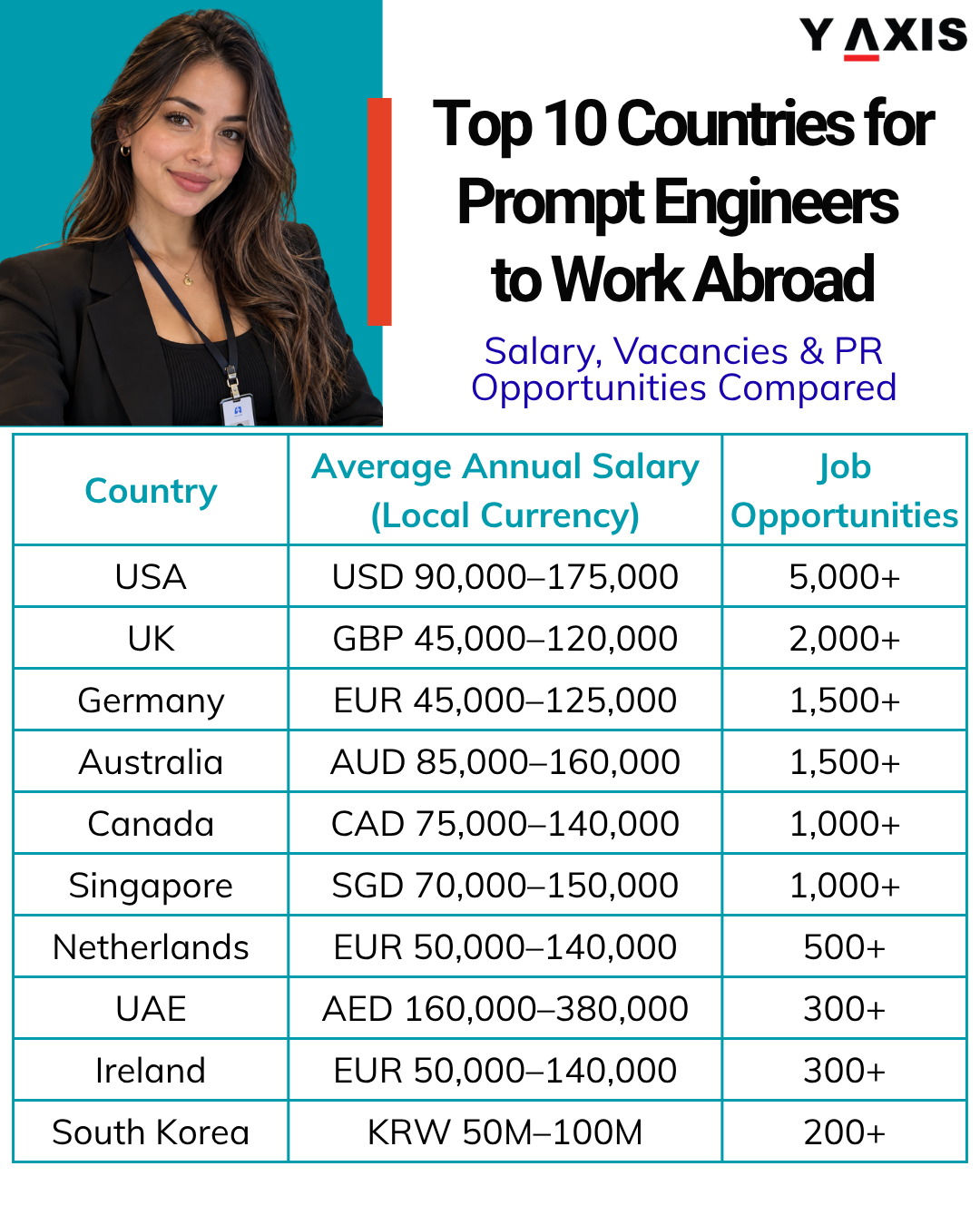
The top 10 countries for Prompt Engineer jobs abroad include the USA, UK, Canada, Germany, Singapore, Australia, Ireland, the Netherlands, South Korea and the UAE. These countries offer competitive salaries, strong demand for Prompt Engineers, work visa options and pathways to permanent residency.
The global AI market is projected to reach USD 3.5 trillion by 2033, growing at a CAGR of 36.6%. The rapid adoption of Generative AI, LLM applications and AI automation is driving strong demand for Prompt Engineers across the technology and software industries. This growth is creating more job opportunities in LLM applications, AI automation and AI-powered workflows in major global technology markets.
*Want to work abroad? Sign up with Y-Axis Resume Marketing Services to find right job faster.
Why many countries are hiring Prompt Engineers globally?
Many countries are hiring Prompt Engineers because businesses increasingly use Generative AI, LLMs and AI automation for software, content, customer support and other processes. Prompt Engineers refine prompts to improve AI outputs and support LLM-based applications. The World Economic Forum expects AI and information-processing technologies to create 11 million jobs by 2030, increasing global demand for AI skills.
- Generative AI adoption: Companies use AI for content, coding, research and customer service.
- LLM applications: Prompt Engineers create and refine prompts for LLM-powered applications.
- AI automation: Businesses use AI workflows to automate repetitive tasks and improve productivity.
- AI assistants: Companies deploy AI assistants and chatbots for customer and employee support.
- Prompt optimisation: Specialists improve AI responses for accuracy, relevance and consistency.
- Cross-industry use: Technology, finance, healthcare, marketing and software companies are adopting AI.
How to Choose the Right Country for Prompt Engineers to Work Abroad?
The right country for Prompt Engineer jobs depends on job demand, salary, work visa options and PR pathways. Countries with strong Generative AI and LLM markets offer more opportunities, while visa eligibility, cost of living and long-term settlement options are important factors to compare before moving abroad.
- Job demand: Check the number of Prompt Engineer and related LLM or Generative AI roles available.
- Salary: Compare average Prompt Engineer salaries with living costs and taxes.
- Work visa: Check whether your qualifications and job offer meet the country’s work visa requirements.
- PR pathway: Review the eligibility, residence requirements and timelines for permanent residency.
- AI job market: Look for demand in LLM applications, AI automation, prompt optimisation and AI development.
- Cost of living: Compare housing, transport, healthcare and other essential expenses with expected income.
Top 10 Countries for Prompt Engineers to Work Abroad
The USA, UK, Canada, Germany and Australia are among the top destinations for Prompt Engineers, with growing demand for Generative AI, LLM applications, AI automation and software development. Prompt Engineers can earn more than AUD 100,000 annually, while demand for AI and machine learning skills continues to rise. The World Economic Forum lists AI and Machine Learning Specialists and Software and Applications Developers among the fastest-growing roles through 2030. Growing demand across global technology markets is creating more opportunities for Prompt Engineers to secure high-paying jobs and build long-term international careers.
| Country | Average Annual Salary (Local Currency) | Estimated Prompt Engineer Job Opportunities |
|---|---|---|
| USA | USD 90,000–175,000 | 5,000+ |
| Canada | CAD 75,000–140,000 | 1,000+ |
| Australia | AUD 85,000–160,000 | 1,500+ |
| Germany | EUR 45,000–125,000 | 1,500+ |
| UK | GBP 45,000–120,000 | 2,000+ |
| Singapore | SGD 70,000–150,000 | 1,000+ |
| UAE | AED 160,000–380,000 | 300+ |
| Netherlands | EUR 50,000–140,000 | 500+ |
| Ireland | EUR 50,000–140,000 | 300+ |
| South Korea | KRW 50 million–100 million | 200+ |
*Want to work abroad? Sign up with Y-Axis Resume Marketing Services to find right job faster.
Best Countries for Prompt Engineers to Work and Settle Abroad
Canada, Australia, Germany, the UK and Ireland have strong AI job markets, competitive salaries and established pathways for skilled workers to gain permanent residency. These countries also have growing demand for Generative AI, LLM applications and AI automation, creating opportunities in technology and software roles. Strong demand for AI skills and clear immigration pathways make these countries strong options for Prompt Engineers looking to work and settle abroad.
Prompt Engineer Jobs in the USA
The USA has one of the largest markets for Prompt Engineer jobs, driven by Generative AI, LLM applications, AI agents and automation. Prompt Engineers design prompts, test LLM responses, evaluate AI outputs, optimise chatbot performance and build AI workflows. More than 22,000 US AI job postings included prompt engineering skills, showing strong demand for this specialised skill. The H-1B visa provides an employer-sponsored route for specialty-occupation technology roles, while EB-2 and EB-3 provide employment-based pathways to permanent residence. The concentration of AI companies, software firms and Generative AI development creates opportunities to work on advanced LLM applications, AI agents and build specialised Prompt Engineering careers in the USA.
| Factor | Details |
|---|---|
| Prompt Engineer Job Market & Job Vacancies for the Next Decade | The USA is expected to generate more than 5,000 Prompt Engineer job opportunities over the next decade, with demand for prompt design, LLM optimisation, Generative AI, AI agents, conversational AI and automation. |
| Investment in Artificial Intelligence & AI Research | The USA is expected to attract nearly USD 600 billion in AI investment, supporting LLM development, Generative AI, AI agents, AI applications and automation. |
| Top Companies Hiring Prompt Engineers | Companies such as OpenAI, Google, Microsoft, Amazon, Meta, Anthropic and IBM hire for roles involving LLMs, Generative AI, AI agents, model evaluation and AI-powered products. |
| Top Cities for Prompt Engineer Jobs | San Francisco Bay Area, Seattle, New York City, Boston, Austin and Washington, DC are major AI hubs, with opportunities in Generative AI, LLM development, enterprise AI and AI research. |
| In-Demand Prompt Engineer Roles & Skills | Roles include Prompt Engineer, Prompt Designer, LLM Specialist, Generative AI Specialist and AI Engineer. Key skills include prompt design, LLM evaluation, Python, RAG, few-shot prompting, AI agents, API integration and model testing. |
| Work Visa Options | The H-1B visa provides an employer-sponsored route for specialised technology and AI positions. Other options include the O-1A visa and employment-based immigration pathways. |
| Fast-Track Hiring Options | USCIS Premium Processing can expedite eligible immigration petitions. Prompt Engineers with achievements in AI research, publications, patents or industry contributions may also consider the O-1A visa. |
| PR / Long-Term Residence Opportunities | Green Card pathways include EB-2, EB-2 National Interest Waiver, EB-3 and EB-1A. The appropriate route depends on qualifications, employer sponsorship and research or industry achievements. |
| Eligibility for Dependents | H-1B visa holders can generally bring their spouse and unmarried children under 21 on H-4 status. O-1A visa holders can bring eligible dependents under O-3 status. |
| Benefits for Family Members | H-4 children can study in the USA, while certain H-4 spouses may qualify for employment authorisation. O-3 dependents can study but generally cannot work. |
Prompt Engineer Jobs in Canada
Canada’s AI and technology sector is creating opportunities for Prompt Engineers working with Generative AI, LLM applications, AI agents and automation. Prompt Engineers design prompts, test LLM responses, evaluate AI outputs, develop chatbots and improve AI workflows. Canada projects more than 250,000 new AI-relevant jobs by 2031, supporting continued demand for LLM and AI skills. The Global Talent Stream provides an employer-sponsored work permit route for technology occupations, while Express Entry and Provincial Nominee Programs (PNPs) provide pathways to permanent residence. Canada’s expanding AI ecosystem gives Prompt Engineers opportunities to work on LLM applications, AI agents and automated workflows while developing specialised Prompt Engineering skills for long-term technology careers.
| Factor | Details |
|---|---|
| Prompt Engineer Job Market & Job Vacancies for the Next Decade | Canada is expected to generate more than 1,000 Prompt Engineer job opportunities over the next decade, with demand for prompt creation, prompt optimisation, LLM testing, AI output evaluation, AI agents, conversational AI and LLM workflow automation. |
| Investment in Artificial Intelligence & AI Research | Canada has committed CAD 2.4 billion to AI infrastructure, research, startups, talent development and business adoption, supporting Generative AI, LLMs, AI assistants and AI agents. |
| Top Companies Hiring Prompt Engineers | Companies such as Cohere, Netomi, MEDFAR and MarkiTech hire for Prompt Engineer and related roles involving LLMs, AI agents, Generative AI and AI-powered software. |
| Top Cities for Prompt Engineer Jobs | Toronto, Montreal, Vancouver and Ottawa are major AI and technology hubs, with opportunities in LLM development, Generative AI products, enterprise software and AI research. |
| In-Demand Prompt Engineer Roles & Skills | Roles include Prompt Engineer, Senior Prompt Designer, LLM Specialist and Generative AI Specialist. Key skills include prompt design, prompt optimisation, LLM evaluation, few-shot prompting, Python, RAG, AI agents, model testing, chatbot development and API integration. |
| Work Visa Options | An employer-specific work permit allows a Prompt Engineer to work for the Canadian employer named on the permit. Many employer-sponsored positions require an LMIA, while some routes are LMIA-exempt. |
| Fast-Track Hiring Options | The Global Talent Stream provides faster processing for specialised technology positions. The Canadian employer submits the required application and Labour Market Benefits Plan before the Prompt Engineer applies for the work permit. |
| PR / Long-Term Residence Opportunities | Prompt Engineers can pursue PR through Express Entry, including the Federal Skilled Worker Program and Canadian Experience Class. Provincial Nominee Programs provide another pathway through provincial nomination. |
| Eligibility for Dependents | A PR application can include a spouse or common-law partner and dependent children under 22. All family members must be declared in the application. |
| Benefits for Family Members | A spouse or common-law partner may qualify for an open work permit, while dependent children can study in Canada with the required study authorisation. |
*Want to work in Canada? Get expert guidance from Y-Axis professionals.
Prompt Engineer Jobs in Australia
Prompt Engineer jobs in Australia are developing around LLM applications, AI agents, Generative AI and automation, particularly within technology and software teams. Prompt Engineers design and refine prompts, test LLM responses, evaluate AI outputs, develop chatbots and improve AI-powered workflows. Australia’s professional occupations are projected to add 845,300 jobs by 2035, supporting continued demand for advanced digital and AI skills. The Skills in Demand visa (subclass 482) provides an employer-sponsored work route, while the Employer Nomination Scheme (subclass 186) provides a pathway to permanent residence. LLM development and AI automation are creating opportunities to apply Prompt Engineering skills to real-world AI projects and build specialised careers within Australia’s technology sector.
| Factor | Details |
|---|---|
| Prompt Engineer Job Market & Job Vacancies for the Next Decade | Australia is expected to generate more than 1,500 Prompt Engineer job opportunities over the next decade, with demand for LLM development, Generative AI, prompt optimisation, AI agents, conversational AI and workflow automation. |
| Investment in Artificial Intelligence & AI Research | Australia is expected to invest more than AUD 1 billion in artificial intelligence, supporting AI research, computing infrastructure, LLM development, Generative AI and AI adoption across businesses and public services. |
| Top Companies Hiring Prompt Engineers | Major companies include Canva, Atlassian, Telstra, Commonwealth Bank, CSIRO, Microsoft and Google, with AI roles focused on LLMs, Generative AI, AI agents, automation and AI-powered products. |
| Top Cities for Prompt Engineer Jobs | Sydney, Melbourne, Brisbane, Canberra and Adelaide are major technology and AI hubs, with opportunities in Generative AI, enterprise AI, software development, automation and AI research. |
| In-Demand Prompt Engineer Roles & Skills | Roles include Prompt Engineer, Prompt Designer, LLM Specialist, Generative AI Specialist and AI Engineer. Key skills include prompt design, prompt optimisation, LLM evaluation, Python, RAG, few-shot prompting, AI agents, API integration and model testing. |
| Work Visa Options | The Skills in Demand visa (subclass 482) allows Australian employers to sponsor overseas applicants for nominated occupations. Applicants must meet the occupation, skills, work experience, English language and visa requirements. |
| Fast-Track Hiring Options | The National Innovation visa (subclass 858) provides a direct permanent visa pathway for highly accomplished individuals, including those with exceptional achievements in technology and AI. |
| PR / Long-Term Residence Opportunities | PR pathways include subclass 189, subclass 190 and subclass 186, depending on the nominated occupation. Subclass 491 holders can apply for subclass 191 after holding the visa for at least 3 years and meeting the income requirement. |
| Eligibility for Dependents | Applicants can include a spouse or de facto partner and dependent children when family inclusion is permitted under the visa. Identity documents and proof of family relationships are required. |
| Benefits for Family Members | Partners can work under their visa conditions, while children can attend Australian schools. Medicare access depends on the family’s visa type and healthcare arrangements. |
*Planning to Work in Australia? Let Y-Axis guide you through every step of the process.
Prompt Engineer Jobs in Germany
Prompt Engineer jobs in Germany are emerging across AI, software and industrial technology, where companies use LLMs, Generative AI and automation for business and production applications. Prompt Engineers work on prompt development, LLM testing, response evaluation, chatbot systems and AI workflows. Germany’s ICT sector is expected to need around 128,000 additional skilled workers by 2030, supporting demand for specialised technology skills. The EU Blue Card provides a work and residence route for technology roles, while the Skilled work visa provides additional routes for skilled IT occupations. The EU Blue Card can lead to permanent settlement after 21 or 27 months, depending on German language proficiency. Germany’s technology sector creates opportunities to work on LLM applications, AI automation and Generative AI projects.
| Factor | Details |
|---|---|
| Prompt Engineer Job Market & Job Vacancies for the Next Decade | Germany is expected to generate more than 1,500 Prompt Engineer job opportunities over the next decade, with demand for LLM development, Generative AI, prompt optimisation, AI agents, conversational AI and enterprise automation. |
| Investment in Artificial Intelligence & AI Research | Germany is expected to invest more than EUR 5 billion in AI research and development, supporting AI infrastructure, LLMs, Generative AI, AI applications and automation. |
| Top Companies Hiring Prompt Engineers | Major companies include SAP, Siemens, Bosch, BMW, Deutsche Telekom, Zalando and Aleph Alpha, with AI roles focused on LLMs, Generative AI, AI agents, automation and AI-powered products. |
| Top Cities for Prompt Engineer Jobs | Berlin, Munich, Hamburg, Frankfurt and Stuttgart are major technology and AI hubs, with opportunities in Generative AI, enterprise AI, software development, automation and AI research. |
| In-Demand Prompt Engineer Roles & Skills | Roles include Prompt Engineer, Prompt Designer, LLM Specialist, Generative AI Specialist and AI Engineer. Key skills include prompt design, prompt optimisation, LLM evaluation, Python, RAG, few-shot prompting, AI agents, API integration and model testing. |
| Work Visa Options | The EU Blue Card provides a work and residence route for Prompt Engineers with a recognised qualification, a German employment contract and the required salary. The Skilled Worker visa is another option for qualifying technology roles. |
| Fast-Track Hiring Options | Germany’s Accelerated Skilled Worker Procedure allows employers to begin the residence process with the foreigners authority before the visa application, helping speed up the immigration process. |
| PR / Long-Term Residence Opportunities | EU Blue Card holders can obtain a settlement permit after 27 months, or after 21 months with B1-level German. Other skilled-worker residence routes can also lead to permanent settlement. |
| Eligibility for Dependents | EU Blue Card holders can generally bring their spouse and minor children through family reunification. Eligible family members can receive residence permits to live in Germany. |
| Benefits for Family Members | Spouses can generally work in Germany without a separate work permit, while children can attend German schools. Family reunification allows eligible family members to live together in Germany. |
*Want to Work in Germany? Let Y-Axis guide you through every step of the process.
Prompt Engineer Jobs in the UK
The UK has a strong market for Prompt Engineer jobs, particularly in Generative AI, LLM applications, AI agents and automation. Prompt Engineers create and optimise prompts, test LLM responses, evaluate AI outputs, develop chatbots and improve AI workflows. The UK government projects that the AI sector could require around 1.3 million additional workers by 2035, indicating substantial future demand for AI skills. The Skilled Worker visa provides an employer-sponsored route for approved technology occupations, while Indefinite Leave to Remain (ILR) provides a route to permanent settlement after the required residence period. The UK’s AI ecosystem gives Prompt Engineers opportunities to work on LLM applications, AI agents and Generative AI projects while building specialised careers in the technology sector.
| Factor | Details |
|---|---|
| Prompt Engineer Job Market & Job Vacancies for the Next Decade | The UK is expected to generate more than 2,000 Prompt Engineer job opportunities over the next decade, with demand for LLM development, Generative AI, prompt optimisation, AI agents, conversational AI and enterprise automation. |
| Investment in Artificial Intelligence & AI Research | The UK is expected to invest more than £1 billion in AI research and development, supporting AI infrastructure, foundation models, Generative AI, AI applications and wider AI adoption. |
| Top Companies & Organisations Hiring Prompt Engineers | Major employers include Google DeepMind, Microsoft, Amazon, Meta, Anthropic, OpenAI and BT, with AI roles focused on LLMs, Generative AI, AI agents, model evaluation and AI-powered products. |
| Top Cities for Prompt Engineer Jobs | London, Cambridge, Oxford, Manchester, Edinburgh and Bristol are major AI and technology hubs, with opportunities in LLM development, Generative AI, enterprise software, AI research and automation. |
| In-Demand Prompt Engineer Roles & Skills | Roles include Prompt Engineer, Prompt Designer, LLM Specialist, Generative AI Specialist and AI Engineer. Key skills include prompt design, prompt optimisation, LLM evaluation, Python, RAG, few-shot prompting, AI agents, API integration and model testing. |
| Work Visa Options | The Skilled Worker visa allows Prompt Engineers to work for approved UK employers in eligible occupations. Applicants need a qualifying job offer, sponsorship and the required salary. |
| Fast-Track Hiring Options | Priority visa processing can speed up eligible applications. Prompt Engineers with recognised achievements in AI research or technology may also consider the Global Talent visa, which does not require employer sponsorship. |
| PR / Long-Term Residence Opportunities | The Skilled Worker route can lead to Indefinite Leave to Remain after five years of qualifying residence. Global Talent holders can qualify for settlement after three or five years, depending on their route. |
| Eligibility for Dependents | Skilled Worker and Global Talent visa holders can generally bring their partner and dependent children through the dependant visa route, subject to the visa rules. |
| Benefits for Family Members | Dependant partners can generally work in the UK, while dependent children can attend UK schools. Family members can also apply for settlement after completing the required residence period. |
Prompt Engineer Jobs in Singapore
Singapore is expanding its AI workforce through Generative AI, LLM applications and automation, creating opportunities for Prompt Engineers in technology, finance and digital services. Prompt Engineers design prompts, test LLM outputs, evaluate responses, develop AI chatbots and optimise AI workflows. Singapore plans to develop 15,000 AI practitioners over three years, strengthening the pipeline for AI engineering and application development. The Employment Pass provides a work route for technology roles, while Employment Pass holders can apply for Singapore Permanent Residence. Singapore’s technology sector and national AI investment create opportunities to work on LLM applications, AI agents and automation systems while developing specialised Prompt Engineering skills and gaining experience with large-scale AI applications.
| Factor | Details |
|---|---|
| Prompt Engineer Job Market & Job Vacancies for the Next Decade | Singapore is expected to generate more than 1,000 Prompt Engineer job opportunities over the next decade, with demand for LLM development, Generative AI, prompt optimisation, AI agents, conversational AI and enterprise automation. |
| Investment in Artificial Intelligence & AI Research | Singapore’s RIE 2030 plan includes S$37 billion for research and innovation, supporting AI research, computing infrastructure, LLM development, Generative AI and advanced digital technologies. |
| Top Companies Hiring Prompt Engineers | Major employers include Google, Microsoft, Amazon, IBM, Grab, Sea Group and DBS, with AI roles focused on LLMs, Generative AI, AI agents, automation and AI-powered products. |
| Top Cities for Prompt Engineer Jobs | Singapore is the country’s main technology and AI hub, with opportunities concentrated in one-north, Fusionopolis and the Central Business District across technology, research, finance and AI teams. |
| In-Demand Prompt Engineer Roles & Skills | Common roles include Prompt Engineer, Prompt Designer, LLM Specialist, Generative AI Specialist and AI Engineer. Key skills include prompt design, prompt optimisation, LLM evaluation, Python, RAG, few-shot prompting, AI agents, API integration and model testing. |
| Work Visa Options | The Employment Pass (EP) is the main work-pass option for Prompt Engineers in professional roles. The S Pass can apply to certain technical positions, subject to salary, quota and employer requirements. |
| Fast-Track Hiring Options | Singapore’s ONE Pass is designed for high-earning individuals and those with outstanding achievements in research, technology or innovation. It provides a separate work-pass route for top talent. |
| PR / Long-Term Residence Opportunities | Employment Pass and S Pass holders can apply for Singapore Permanent Residence. Assessment considers factors such as qualifications, salary, employment history, length of residence and contributions to Singapore. |
| Eligibility for Dependents | Employment Pass holders earning at least S$6,000 monthly can generally bring their legally married spouse and unmarried children under 21 through Dependant’s Passes. |
| Benefits for Family Members | Dependant’s Pass holders can live in Singapore with the primary pass holder. Spouses need work authorisation to work, while dependent children can attend Singapore schools subject to admission requirements. |
Prompt Engineer Jobs in the UAE
The UAE is building a strong AI ecosystem around Generative AI, LLM applications, AI agents and automation, creating opportunities for Prompt Engineers in technology and digital services. Prompt Engineers design prompts, test LLM responses, evaluate AI outputs, develop chatbots and improve AI workflows. The UAE National Strategy for Artificial Intelligence 2031 aims to establish the country as a global AI leader and expand AI adoption across key sectors. The employment visa provides a standard route to work for an employer, while the Green Visa provides longer-term residence through self-sponsorship for specified categories. The Golden Visa includes routes for specialised AI talent. This expanding AI ecosystem creates opportunities to work on LLM applications, AI agents and automation projects in the UAE.
| Factor | Details |
|---|---|
| Prompt Engineer Job Market & Job Vacancies for the Next Decade | The UAE is expected to generate more than 300 Prompt Engineer job opportunities over the next decade, with demand for LLM development, Generative AI, prompt optimisation, AI agents, conversational AI and workflow automation. |
| Investment in Artificial Intelligence & AI Research | The UAE is investing AED 11 billion in advanced technology, supporting AI infrastructure, research, LLM development, Generative AI, automation and wider technology adoption. |
| Top Companies Hiring Prompt Engineers | Major employers include G42, Presight, Microsoft, Google, Amazon and IBM, with AI roles focused on LLMs, Generative AI, AI agents, automation and AI-powered products. |
| Top Cities for Prompt Engineer Jobs | Dubai and Abu Dhabi are the UAE’s main AI and technology hubs, with opportunities in Generative AI, LLM applications, enterprise AI, automation and AI research. |
| In-Demand Prompt Engineer Roles & Skills | Roles include Prompt Engineer, Prompt Designer, LLM Specialist, Generative AI Specialist and AI Engineer. Key skills include prompt design, prompt optimisation, LLM evaluation, Python, RAG, few-shot prompting, AI agents, API integration and model testing. |
| Work Visa Options | Most Prompt Engineers work in the UAE through an employer-sponsored residence visa. Green Residency provides five-year residence, while Golden Residency provides five- or ten-year residence under designated categories. |
| Fast-Track Hiring Options | Prompt Engineers with strong achievements in AI, technology or research can explore Golden Residency categories for specialised talent, subject to the relevant category and approval. |
| PR / Long-Term Residence Opportunities | The UAE does not provide conventional permanent residence through employment. Prompt Engineers can maintain long-term residence through Green Residency or Golden Residency. |
| Eligibility for Dependents | Green and Golden Residency holders can generally sponsor their spouse and children by providing identity documents and proof of family relationships. |
| Benefits for Family Members | Sponsored family members can live and study in the UAE. Spouses can work after obtaining the required employment authorisation, while their residence remains linked to the sponsor’s valid status. |
Prompt Engineer Jobs in the Netherlands
The Netherlands is applying Generative AI across technology, software and digital businesses, creating opportunities for Prompt Engineers in LLM applications, AI automation and AI-powered products. Prompt Engineers design prompts, test LLM responses, evaluate AI outputs, develop chatbots and optimise AI workflows. Around 37.1% of workers in the Netherlands are exposed to Generative AI, above the OECD average of 26%, showing the significant reach of GenAI across the Dutch labour market. The Highly Skilled Migrant scheme provides an employer-sponsored work route, while permanent residence can be obtained after five years of continuous legal residence. The Netherlands’ digital economy provides opportunities to work on LLM applications, AI agents and Generative AI systems while developing specialised Prompt Engineering expertise.
| Factor | Details |
|---|---|
| Prompt Engineer Job Market & Job Vacancies for the Next Decade | The Netherlands is expected to generate more than 500 Prompt Engineer job opportunities over the next decade, with demand for LLM development, Generative AI, prompt optimisation, AI agents, conversational AI and enterprise automation. |
| Investment in Artificial Intelligence & AI Research | The Netherlands is investing more than EUR 2 billion in AI and digital innovation, supporting AI research, computing infrastructure, LLM development, Generative AI and AI applications. |
| Top Companies Hiring Prompt Engineers | Major employers include ASML, Philips, ING, Booking.com, Adyen, Shell and Microsoft, with AI roles focused on LLMs, Generative AI, AI agents, automation and AI-powered products. |
| Top Cities for Prompt Engineer Jobs | Amsterdam, Eindhoven, Utrecht, Rotterdam, Delft and The Hague are major technology and AI hubs, with opportunities in Generative AI, enterprise software, financial technology, semiconductor technology and AI research. |
| In-Demand Prompt Engineer Roles & Skills | Common roles include Prompt Engineer, Prompt Designer, LLM Specialist, Generative AI Specialist and AI Engineer. Key skills include prompt design, prompt optimisation, LLM evaluation, Python, RAG, few-shot prompting, AI agents, API integration and model testing. |
| Work Visa Options | The Highly Skilled Migrant permit is a primary route for Prompt Engineers employed by an IND-recognised sponsor. The EU Blue Card is another option for applicants meeting its salary, employment and qualification requirements. |
| Fast-Track Hiring Options | IND-recognised employers can submit Highly Skilled Migrant applications directly to the IND, streamlining the residence permit process for overseas Prompt Engineers. |
| PR / Long-Term Residence Opportunities | Prompt Engineers can generally apply for permanent residence after five years of lawful residence, provided they meet the residence, income, permit and civic integration requirements. |
| Eligibility for Dependents | Residence permit holders can generally bring their spouse, registered partner and dependent children to the Netherlands through family reunification. |
| Benefits for Family Members | A Highly Skilled Migrant’s spouse or partner can generally work without a separate work permit, while dependent children can live in the Netherlands and attend Dutch schools. |
Prompt Engineer Jobs in Ireland
Ireland has a strong technology sector for Prompt Engineer jobs, with demand for Generative AI, LLM applications, AI agents and automation across software and digital businesses. Prompt Engineers design prompts, test LLM responses, evaluate AI outputs, develop chatbots and optimise AI workflows. Ireland’s labour market is generating AI jobs at two to three times the pace of peer EU countries, according to the latest government assessment. The Critical Skills Employment Permit provides a route for listed ICT and technology occupations, while holders can move to Stamp 4 after 21 months, allowing them to work without an employment permit. Ireland’s expanding AI market creates opportunities to work on LLM applications, AI agents and Generative AI projects while developing specialised Prompt Engineering expertise.
| Factor | Details |
|---|---|
| Prompt Engineer Job Market & Job Vacancies for the Next Decade | Ireland is expected to generate more than 300 Prompt Engineer job opportunities over the next decade, with demand for LLM development, Generative AI, prompt optimisation, AI agents, conversational AI and enterprise automation. |
| Investment in Artificial Intelligence & AI Research | Ireland is expected to invest more than €1 billion in AI and digital transformation, supporting AI research, computing infrastructure, LLM development, Generative AI and AI adoption across businesses and public services. |
| Top Companies Hiring Prompt Engineers | Major employers include Google, Microsoft, Meta, IBM, Accenture, HubSpot and Salesforce, with AI roles focused on LLMs, Generative AI, AI agents, automation and AI-powered products. |
| Top Cities for Prompt Engineer Jobs | Dublin, Cork, Galway, Limerick and Waterford are key technology hubs, with opportunities in Generative AI, enterprise software, financial technology, cloud computing and AI research. |
| In-Demand Prompt Engineer Roles & Skills | Common roles include Prompt Engineer, Prompt Designer, LLM Specialist, Generative AI Specialist and AI Engineer. Key skills include prompt design, prompt optimisation, LLM evaluation, Python, RAG, few-shot prompting, AI agents, API integration and model testing. |
| Work Visa Options | The Critical Skills Employment Permit covers listed technology occupations that meet the required salary threshold. The General Employment Permit provides another route for roles that meet its occupation and salary criteria. |
| Fast-Track Hiring Options | The Critical Skills Employment Permit does not require a Labour Market Needs Test, allowing employers to recruit overseas applicants without completing that test. Applicants must meet the permit’s occupation, salary and employment criteria. |
| PR / Long-Term Residence Opportunities | Critical Skills Employment Permit holders can generally move to Stamp 4 after two years of employment. Long-term residence can be available after 60 months of qualifying residence. |
| Eligibility for Dependents | Critical Skills Employment Permit holders can generally bring their spouse, partner and dependent children through Ireland’s family reunification process. |
| Benefits for Family Members | Spouses and partners of Critical Skills Employment Permit holders can generally work in Ireland without a separate employment permit. Dependent children can attend Irish schools under the applicable rules. |
Prompt Engineer Jobs in South Korea
South Korea is expanding its AI and software sector for LLM applications, AI agents, Generative AI and automation, creating opportunities for Prompt Engineers in technology companies. Prompt Engineers design and refine prompts, test LLM responses, evaluate AI outputs, improve chatbot performance and build AI workflows. The South Korean government launched AI Campus to train 10,000 AI specialists, focusing on AI engineering and AI application development. The E-7 visa provides a work route for specialised technology occupations, while the D-10 visa provides a route to stay in South Korea while seeking professional employment. Investment in AI engineering and applications creates opportunities to work on LLM projects, AI agents and automated AI solutions while developing specialised Prompt Engineering skills.
| Factor | Details |
|---|---|
| Prompt Engineer Job Market & Job Vacancies for the Next Decade | South Korea is expected to generate more than 200 Prompt Engineer job opportunities over the next decade, with demand for LLM development, Generative AI, prompt optimisation, AI agents, conversational AI and automation. |
| Investment in Artificial Intelligence & AI Research | South Korea is investing KRW 5.1 trillion in AI transformation, funding AI computing infrastructure, research, talent development, LLMs, AI semiconductors and AI applications. |
| Top Companies Hiring Prompt Engineers | Major employers include Samsung, Naver, Kakao, LG, SK Telecom, Hyundai Motor and Samsung SDS, with AI roles focused on LLMs, Generative AI, AI agents, automation and AI-powered products. |
| Top Cities for Prompt Engineer Jobs | Seoul is the main AI and technology hub, while Daejeon, Pangyo and Busan also have AI and software roles in LLM development, enterprise AI, automation and research. |
| In-Demand Prompt Engineer Roles & Skills | Roles include Prompt Engineer, Prompt Designer, LLM Specialist, Generative AI Specialist and AI Engineer. Key skills include prompt design, LLM evaluation, Python, RAG, few-shot prompting, AI agents, API integration and model testing. |
| Work Visa Options | The E-7 visa covers specialised occupations and can apply to eligible technology roles. The D-10 visa allows foreign graduates and skilled applicants to stay in South Korea while seeking professional employment. |
| Fast-Track Hiring Options | The E-7 visa provides a direct work route when a South Korean employer sponsors an eligible technology position. Applicants must meet the occupation, qualification and employment requirements for the selected E-7 category. |
| PR / Long-Term Residence Opportunities | E-7 holders can move to the F-2-7 points-based residence visa after meeting the required residence period and points criteria. F-5 permanent residence can follow after meeting the requirements for the relevant F-5 category. |
| Eligibility for Dependents | E-7 visa holders can generally bring their spouse and unmarried minor children to South Korea under the F-3 dependent family visa. |
| Benefits for Family Members | F-3 dependents can live in South Korea with the E-7 visa holder. Children can attend Korean schools, while F-3 holders generally need separate immigration permission to undertake employment. |
Job Outlook for Prompt Engineers over the Next Decade
The job outlook for Prompt Engineers is very positive over the next decade due to the increasing use of Generative AI, large language models (LLMs), AI agents and automated workflows across businesses. Globally, the World Economic Forum projects 170 million new jobs by 2030, with AI and big data among the fastest-growing skills. Demand is also expanding into LLM Engineer, Generative AI Engineer, AI Engineer and AI Application Specialist roles. Skills such as prompt design, LLM evaluation, RAG, AI agents, Python, API integration and model testing will remain important, creating opportunities to work on AI applications, intelligent automation, LLM-powered products and enterprise AI solutions worldwide.
*Want to work abroad? Sign up with Y-Axis Resume Marketing Services to find right job faster.
FAQs
Which countries have the highest demand for Prompt Engineers?
The USA, Canada, Australia, Germany, the UK, Singapore, the Netherlands, Ireland, the UAE and South Korea have opportunities involving Prompt Engineering, LLM development, Generative AI, AI agents and automation. Many employers advertise these positions as LLM Engineer, Generative AI Engineer, AI Engineer or AI Specialist roles.
How much does a Prompt Engineer earn abroad?
Prompt Engineer salaries vary by country, experience and technical specialization. Typical annual ranges include USD 90,000–175,000 in the USA, CAD 75,000–140,000 in Canada, AUD 85,000–160,000 in Australia and GBP 45,000–120,000 in the UK.
Which country pays the highest salary for Prompt Engineers?
The USA offers some of the highest Prompt Engineer salaries internationally, particularly in technology hubs such as San Francisco, Seattle, New York and Boston. Experienced candidates with LLM development, Python, RAG, AI-agent and evaluation skills can access higher-paying positions.
Are Prompt Engineer jobs available abroad?
Yes. International vacancies include Prompt Engineer, LLM Engineer, Generative AI Engineer, AI Engineer and AI Specialist roles. Employers commonly seek skills in prompt design, LLM evaluation, RAG, Python, API integration, AI agents, automation and model testing for production AI applications.
How can I get a Prompt Engineer job abroad?
Build skills in prompt design, LLM evaluation, RAG, Python, APIs and AI agents. Create practical projects demonstrating these skills, prepare an AI-focused portfolio and apply for Prompt Engineer, LLM Engineer, Generative AI Engineer and AI Engineer positions matching your experience.
What qualifications do I need to become a Prompt Engineer?
A degree in computer science, artificial intelligence, data science, software engineering or a related field can support Prompt Engineer applications. Employers also value practical LLM experience, AI projects, programming skills, prompt evaluation knowledge and experience building AI-powered applications.
What skills are required for Prompt Engineer jobs?
Core skills include prompt design, prompt optimisation, few-shot prompting, LLM evaluation, RAG, Python, API integration, structured outputs, AI agents, model testing and output analysis. Knowledge of OpenAI, Anthropic, Google or other LLM APIs can also support Prompt Engineering roles.
Do Prompt Engineers need coding skills?
Coding requirements depend on the role. Prompt-focused positions may require limited programming, while LLM and Generative AI roles commonly require Python, APIs, data handling and automation. Learning Python, API integration and basic software development can significantly expand the number of roles available.
Do I need a computer science degree to become a Prompt Engineer?
No. A computer science degree is not mandatory for every Prompt Engineer position. Employers may consider demonstrated LLM knowledge, AI project experience, prompt evaluation, programming ability and relevant domain expertise. Technical qualifications become more important for LLM Engineer and production AI development roles.
Can freshers get Prompt Engineer jobs abroad?
Freshers can target entry-level AI, LLM and AI automation positions, although dedicated Prompt Engineer roles may request practical experience. A portfolio containing RAG applications, prompt-testing projects, AI agents, LLM evaluations and API integrations can demonstrate practical skills to international employers.
What jobs can I get with Prompt Engineering skills?
Prompt Engineering skills can support careers as a Prompt Engineer, LLM Engineer, Generative AI Engineer, AI Engineer, AI Specialist, AI Application Specialist, Conversational AI Designer or AI Agent Engineer. The strongest opportunities often combine prompt skills with programming, LLM evaluation, RAG and automation.
Which companies hire Prompt Engineers?
Companies hiring for Prompt Engineering and related AI skills include Google, Microsoft, Amazon, Meta, OpenAI, Anthropic and IBM. Technology companies, consulting firms, financial institutions and software businesses also recruit for LLM and Generative AI roles where prompt design and evaluation are required.
How can I find Prompt Engineer jobs overseas?
Search international job boards and company career pages using titles such as Prompt Engineer, LLM Engineer, Generative AI Engineer, AI Engineer, AI Specialist and AI Application Specialist. Also search for RAG, LLM evaluation and AI-agent roles because Prompt Engineering is often included within broader AI positions.
Which work visas are available for Prompt Engineers?
Eligible Prompt Engineers can use skilled-worker or technology visa routes such as the H-1B in the USA, Global Talent Stream in Canada, Skills in Demand visa in Australia, EU Blue Card in Germany, Skilled Worker visa in the UK and Employment Pass in Singapore.
Can Prompt Engineers get permanent residency abroad?
Yes. Eligible Prompt Engineers can pursue PR through routes such as Express Entry and Provincial Nominee Programs in Canada, skilled and employer-sponsored pathways in Australia, employment-based Green Cards in the USA, settlement routes in Germany and ILR in the UK.
Which countries offer PR pathways for Prompt Engineers?
Canada, Australia, Germany, the UK, the Netherlands and Ireland have established permanent-residence or long-term residence pathways for eligible technology workers. The applicable route depends on the applicant’s occupation, qualifications, salary, work experience, employer sponsorship and the country's immigration category.
Can Prompt Engineers take their family abroad?
Yes. Many skilled-worker visas allow eligible Prompt Engineers to bring a spouse or partner and dependent children. Depending on the destination, family members may receive residence rights, work authorisation or study rights. The exact benefits depend on the primary applicant’s visa category.
What are the most in-demand Prompt Engineer roles abroad?
International demand extends to LLM Engineer, Generative AI Engineer, AI Engineer, AI Specialist, AI Application Specialist and AI Agent Engineer roles. Employers increasingly combine prompt engineering with LLM development, RAG, Python, evaluation, API integration, AI agents and workflow automation.
Is Prompt Engineering still a career?
Yes. Prompt Engineering remains relevant, but many employers now combine it with broader AI and LLM responsibilities. Candidates with prompt design plus LLM evaluation, RAG, Python, APIs, AI agents and automation skills can target both dedicated Prompt Engineer positions and wider AI roles.
What is the future of Prompt Engineer jobs?
The role is increasingly connected with LLM applications, Generative AI, RAG, AI agents, evaluation and automation. Prompt Engineers who develop technical skills in Python, APIs, model testing and AI application development can target a broader range of international AI and LLM opportunities.
Posted on September 29 2026
Trending Article
Posted On October 19 2026
Canada vs. Australia for IT Professionals: Which Country Should You Choose?