


Don't know what to do ?.
Get Free Counseling
Last Updated: 27 October 2026
Australia Subclass 494 Visa: Requirements, Fees, Benefits & Application Process
The Skilled Employer Sponsored Regional (Provisional) visa (subclass 494) allows eligible skilled workers to live and work in designated regional areas of Australia for up to five years. To qualify, you must be nominated by an eligible regional employer, have the required skills and work experience, and meet the visa's age, English language and other eligibility requirements. This visa helps Australian regional employers fill skilled job vacancies with qualified overseas workers. It also offers a pathway to permanent residence for eligible applicants. After meeting the required conditions, including holding an eligible visa for at least three years, you may be able to apply for permanent residence through the Skilled Regional visa (subclass 191).
Key facts about the Subclass 494 visa
| Key fact | Current information |
|---|---|
| Visa type | Temporary, provisional skilled visa |
| Visa validity | Up to 5 years |
| Age | Generally under 45 at application, unless exempt |
| Work experience | At least 3 years of relevant experience in the nominated occupation |
| Minimum salary threshold | AUD 79,423 from 1 July 2026, subject to the applicable rules |
| Main applicant visa fee | AUD 6,140 |
| Permanent residence pathway | Subclass 191, if eligible after at least 3 years |
| Points test | No points test for the subclass 494 visa |
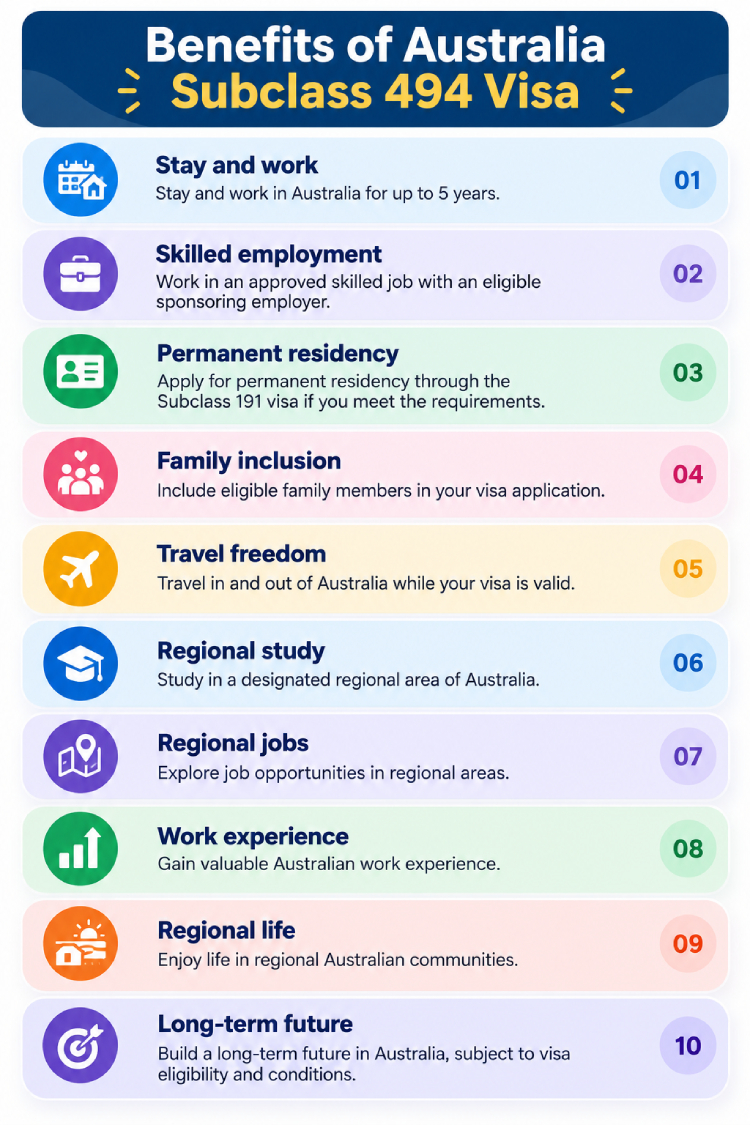
Benefits of Australia Subclass 494 Visa
- Stay and work in Australia for up to 5 years.
- Work in an approved skilled job with an eligible sponsoring employer.
- Apply for permanent residency through the Subclass 191 visa if you meet the requirements.
- Include eligible family members in your visa application.
- Travel in and out of Australia while your visa is valid.
- Study in a designated regional area of Australia.
- Explore job opportunities in regional areas.
- Gain valuable Australian work experience.
- Enjoy life in regional Australian communities.
- Build a long-term future in Australia, subject to visa eligibility and conditions.
What is the 494 Subclass Visa?
The Subclass 494 visa is granted to eligible immigration candidates with the required skills and job offers from employers in the regional areas of Australia. These employers will sponsor candidates only after demonstrating to their government that they couldn’t employ a skilled Australian worker for this position. The validity of this visa is up to five years. Applicants for this visa need to be nominated by an employer in Australia who will sponsor them.
The applicant must be under 45 at the time of applying for this visa. Other criteria for Subclass 494 include that the applicant must:
- Be employed in an occupation that is listed on the skilled occupation list
- Have suitable skills assessment of skills for the occupation
- Have required language proficiency in English
Overview of Subclass 494 Visa (Skilled Employer Sponsored Regional – Provisional)
The Australian Subclass 494 visa allows eligible skilled workers to live and work in designated regional areas of Australia for up to five years. Applicants generally need nomination from an eligible regional employer and must meet the relevant visa requirements.
The visa has two primary streams for skilled workers, plus a separate Subsequent Entrant pathway for eligible family members.
- Visa streams: Employer Sponsored and Labour Agreement.
- Where you can live and work: Designated regional areas of Australia. Sydney, Melbourne and Brisbane are excluded.
- Visa duration: Up to five years, with multiple travel entries.
- Work rights: Work in line with your visa conditions and nominated employment arrangements.
- Family members: Eligible family members can be included or may apply later as subsequent entrants.
- Healthcare: Medicare eligibility depends on the applicable rules and your circumstances.
- Permanent residence: Eligible visa holders may apply for the Subclass 191 permanent residence visa after meeting the required conditions.
Subclass 494 Visa Streams
Employer Sponsored Stream
The Employer Sponsored stream allows eligible regional employers to nominate skilled workers when they cannot find suitable Australian workers for the position. Applicants must meet the relevant occupation, qualification, work experience, English language and other visa requirements.
With this stream, eligible visa holders can:
- Live and work in designated regional areas of Australia for up to five years.
- Travel to and from Australia multiple times while the visa remains valid.
- Include eligible family members in the application.
- Potentially apply for permanent residence through the Subclass 191 visa after meeting the relevant requirements.
Labour Agreement Stream
The Labour Agreement stream is for skilled workers nominated by employers that have entered into an approved labour agreement with the Australian Government. These agreements are used when standard skilled visa arrangements do not meet an employer's workforce needs. Certain concessions may be available if the agreement permits them.
With this stream, eligible visa holders can:
- Live, work and study in designated regional areas of Australia for up to five years.
- Travel to and from Australia multiple times while the visa remains valid.
- Include eligible family members in the application.
- Potentially apply for permanent residence through the Subclass 191 visa if they meet the applicable conditions.
Subsequent Entrant Pathway
The Subsequent Entrant pathway allows eligible family members of a Subclass 494 visa holder to apply to join them in Australia. Family members must meet the relevant relationship and visa requirements and generally submit a separate application.
With this pathway, eligible family members can:
- Join the primary visa holder in Australia.
- Live in Australia while their visa remains valid.
- Travel to and from Australia multiple times during the visa validity period.
- Work or study in accordance with their visa conditions.
Important: The Employer Sponsored and Labour Agreement streams are the two primary streams for skilled workers. The Subsequent Entrant pathway is for eligible family members, not a third primary skilled-worker stream. Permanent residence is not automatic; applicants must separately meet the Subclass 191 requirements.
Eligibility Criteria for the Subclass 494 Visa
To apply for Australia's Skilled Employer Sponsored Regional (Provisional) visa (subclass 494), you must meet the age, skills, work experience, English language and other visa requirements.
- Employer nomination: You must be nominated by an eligible employer operating in a designated regional area of Australia.
- Eligible occupation: Your nominated occupation must meet the requirements of the relevant skilled occupation list or an applicable labour agreement.
- Skills assessment: You generally need a suitable skills assessment for your nominated occupation, unless an exemption applies.
- Work experience: You generally need at least three years of relevant work experience in your nominated occupation.
- Age requirement: You must be under 45 years old when you apply, unless an exemption applies.
- English language: You must meet the required English language level unless an exemption applies.
- Regional employment: You must comply with the visa conditions relating to your nominated employment and designated regional area.
- Health and character: You and any included family members must meet the applicable health and character requirements.
Subclass 494 Visa Requirements
- Age: You must be under 45 when applying, unless an exemption applies.
- Employer Nomination: You must be nominated by an eligible employer in regional Australia.
- Occupation: Your nominated occupation must meet the relevant skilled occupation list or labour agreement requirements.
- Skills Assessment: You must have a suitable skills assessment unless an exemption applies.
- Work Experience: You generally need at least three years of relevant work experience.
- English Language: You must meet the required English language level unless exempt.
- Regional Employment: You must follow the visa conditions for working in a designated regional area.
- Health and Character: You and your included family members must meet Australia's health and character requirements.
- Australian Values Statement: You may need to sign or agree to the Australian Values Statement, depending on your circumstances.
- Previous Visa History: Past visa refusals or cancellations must be declared and may affect your application.
- Government Debts: You must repay any outstanding Australian Government debts or make acceptable repayment arrangements, where required.
Checklist for the Skilled Employer Sponsored Regional (Provisional) Visa (Subclass 494)
When applying for a Subclass 494 visa, prepare the relevant documents to prove your identity, qualifications, work experience and eligibility. The documents required may vary depending on your circumstances and visa stream.
| Document category | Required documents |
|---|---|
| Identity documents | Passport pages showing personal details, photograph, issue date and expiry date; identity card, if required. |
| Name change documents | Marriage or divorce certificates, official name change records, and documents showing other names used. |
| Age exemption documents | Supporting evidence if you are claiming an age exemption. |
| Qualifications and skills | Skills assessment from the relevant authority, where required; educational certificates; CV or résumé; employment references and evidence of work experience. |
| Professional registration | Licences, registrations or documents showing that you meet the relevant Australian professional registration requirements. |
| English language proficiency | Evidence that you meet the required English language standard, unless exempt. |
| Character documents | Australian and overseas police certificates, where required, and military service records or discharge papers if applicable. |
| Partner identity and marital status | Identity documents and evidence of marital status. |
| Relationship evidence | Joint bank statements, shared bills, documents showing a shared address, joint rental agreements or mortgages, and other evidence of your relationship. |
| Dependants under 18 | Identity documents, character documents if required, and evidence of parental responsibility or consent where applicable. |
| Dependants aged 18 or over | Identity documents, character documents, evidence of dependency and details of other relationships, if required. |
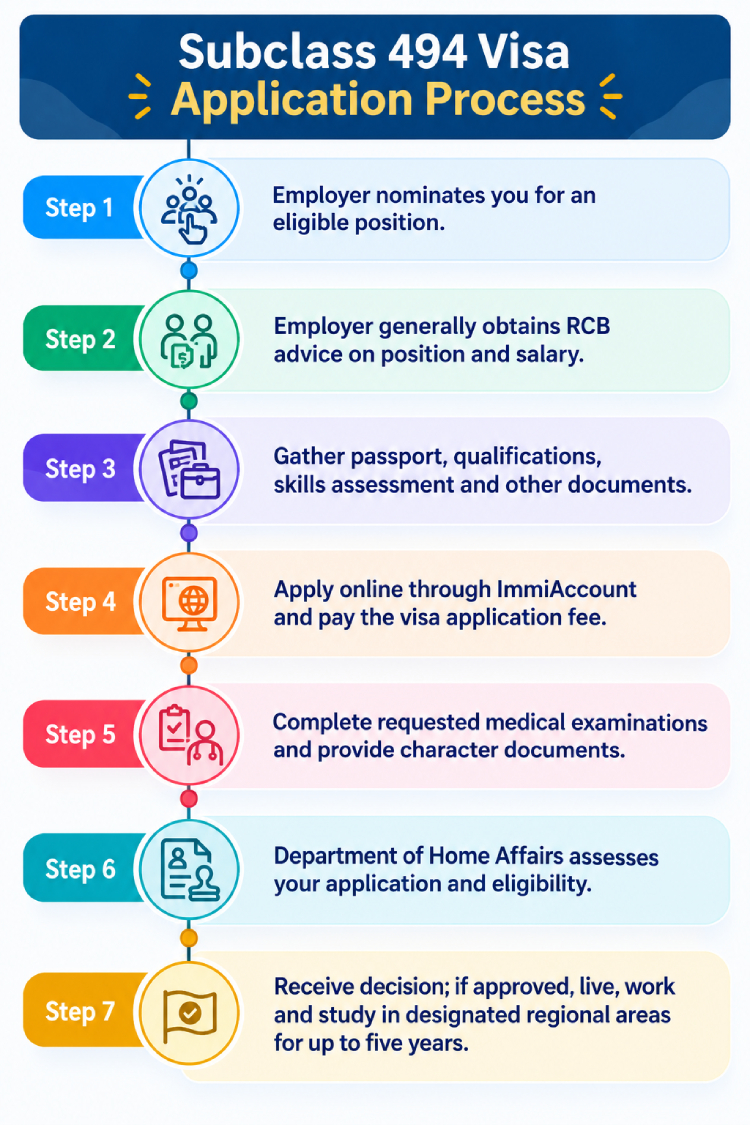
Step-by-Step Application Process for the Subclass 494 Visa
Step 1: Employer nomination Your regional employer must be an approved sponsor or obtain the required approval and nominate you for an eligible position.
Step 2: Regional Certifying Body (RCB) advice For the Employer Sponsored stream, the employer generally needs RCB advice about the nominated position and salary.
Step 3: Prepare your documents Gather your passport, qualifications, skills assessment, work experience evidence, English test results and other required documents.
Step 4: Submit your visa application Apply online through ImmiAccount and pay the visa application fee. Follow the instructions for linking your application to the employer's nomination.
Step 5: Complete health and character checks Complete medical examinations if requested and provide police certificates and other character documents as required.
Step 6: Wait for assessment The Department of Home Affairs assesses your application, nomination and eligibility against the visa requirements.
Step 7: Receive the visa decision If approved, you can live, work and study in designated regional areas of Australia for up to five years, subject to your visa conditions.
Subclass 494 Visa Processing Time
The time needed to process a Subclass 494 visa depends on your visa type, documents and the checks required by the Australian Government.
| Applications processed | Employer Sponsored stream | Labour Agreement stream |
|---|---|---|
| 25% of applications | 3 months | 2 months |
| 50% of applications | 8 months | 4 months |
| 75% of applications | 11 months | 11 months |
| 90% of applications | 12 months | 12 months |
These are estimated processing times based on previously decided applications. They are not guaranteed waiting times.
Factors That Affect Processing Time
- Complete documents: Missing documents can delay your application.
- Response time: Replying quickly to requests for more information can help avoid delays.
- Health and character checks: Medical tests and police certificates may take time.
- Document checks: Checking your qualifications and work experience can affect processing.
- Employer nomination: Problems with your employer's nomination may delay your application.
- Application demand: The number of applications being processed can affect waiting times.
Key Visa Conditions for Subclass 494
Subclass 494 visa holders must follow specific conditions to maintain their visa status and remain eligible for future permanent residence.
Regional Location Restrictions
- You must live, work and study in designated regional areas of Australia, based on the official postcode rules.
- Living or working outside the permitted areas may breach your visa conditions.
Employer and Occupation Restrictions
- You must work in your nominated occupation and follow the conditions linked to your sponsoring employer.
- If you stop working for your sponsor, you may have up to 180 consecutive days at a time and 365 days in total during your visa period to find another sponsor, apply for another visa or make other permitted arrangements.
- During the permitted period, you may be able to work for another employer, subject to the applicable visa conditions.
Minimum Salary Requirements (TSMIT)
- From 1 July 2026, the Temporary Skilled Migration Income Threshold (TSMIT) is AUD 79,423 per year.
- Your salary must also meet the applicable Annual Market Salary Rate (AMSR) requirements.
- Employers must follow the relevant salary and employment conditions for the nominated position.
Visa Duration and Permanent Residence
- The Subclass 494 visa allows eligible holders to live, work and study in designated regional areas for up to five years.
- After holding an eligible visa for at least three years, you may be able to apply for permanent residence through the Subclass 191 visa.
- You must meet the relevant visa conditions and provide the required tax assessment notices. There is no minimum income threshold for the Subclass 191 Regional Provisional stream.
Family Members
- Eligible family members can be included in your application or apply later through the Subsequent Entrant pathway.
- Family members must follow the conditions attached to their visas and meet the relevant requirements.
Important: Salary thresholds and visa conditions can change. Check the latest Australian immigration rules before applying or making changes to your employment.
Pathway to Permanent Residence via Subclass 191
Holders of the Subclass 494 (Skilled Employer Sponsored Regional – Provisional) visa may be eligible to apply for permanent residence through the Subclass 191 visa after meeting the required conditions.
To qualify, you must generally meet the following requirements:
- Regional Residence: You must have held an eligible regional visa for at least three years and meet the applicable visa conditions.
- Tax Assessment Notices: You must provide Australian Taxation Office (ATO) notices of assessment for three income years out of the five years you held the eligible visa.
- No Minimum Income Threshold: There is no minimum taxable income requirement for the Subclass 191 Regional Provisional stream. You do not need to earn the Temporary Skilled Migration Income Threshold (TSMIT) to qualify.
- Visa Compliance: You must have complied with the conditions of your Subclass 494 visa.
- Family Inclusion: Eligible family members may also apply for permanent residence if they meet the relevant requirements.
Once granted, the Subclass 191 visa allows you to live and work permanently anywhere in Australia. You may also access Medicare, sponsor eligible relatives and apply for Australian citizenship when you meet the relevant eligibility requirements.
Subclass 494 vs 491 vs 482 vs 485 Visa
Australia offers different visas for skilled workers, regional workers and international graduates. Each visa has different rules for sponsorship, work, salary and permanent residence.
| Feature | Subclass 494 – Regional Employer Sponsored | Subclass 491 – Skilled Work Regional | Subclass 482 – Skills in Demand | Subclass 485 – Temporary Graduate |
|---|---|---|---|---|
| Main purpose | Work for an eligible employer in regional Australia | Live and work in regional Australia as a skilled worker | Work for an employer sponsoring your skills | Work in Australia after completing eligible studies |
| Where you can live and work | Designated regional areas | Designated regional areas | Depends on your employer and visa conditions | Anywhere in Australia, subject to visa conditions |
| Visa duration | Up to 5 years | Up to 5 years | Up to 4 years in most streams | Usually 2–3 years, depending on the stream |
| Sponsorship | Requires an eligible regional employer | Requires state or territory nomination or eligible family sponsorship | Requires an eligible sponsoring employer | No employer sponsorship required |
| Age limit | Generally under 45, unless exempt | Generally under 45, unless exempt | No general under-45 age limit | Generally 35 or under, with exceptions |
| Work experience | Generally at least 3 years of relevant experience | Depends on the occupation and visa requirements | Generally at least 1 year of relevant experience | Must meet the relevant graduate visa requirements |
| Skills assessment | Generally required, unless exempt | Required for the nominated occupation, where applicable | Required for certain occupations | Depends on the visa stream and qualification |
| Points test | Not required | Required | Not required | Not required |
| Salary requirements | At least AUD 79,423 per year, plus applicable market salary rules | No minimum salary threshold under TSMIT | Core Skills: AUD 79,423; Specialist Skills: AUD 146,576, plus applicable salary rules | No skilled visa salary threshold |
| Permanent residence pathway | May lead to Subclass 191 | May lead to Subclass 191 | May lead to Subclass 186 if eligible | No direct permanent residence pathway |
Which visa should you consider?
- Subclass 494: If you have a job offer from an eligible employer in regional Australia.
- Subclass 491: If you qualify for skilled migration through state nomination or eligible family sponsorship.
- Subclass 482: If an eligible Australian employer wants to sponsor you for a skilled job.
- Subclass 485: If you have completed an eligible course in Australia and want to gain work experience.
Note: Subclass 494 and 491 visa holders may qualify for permanent residence through Subclass 191 after meeting the required conditions. Permanent residence is not automatic.
How Can Y-Axis Help You?
- Free eligibility check through Australia Immigration Points Calculator
- Expert guidance/counseling for Australia Immigration
- Coaching services: Expert PTE coaching, IELTS proficiency Coaching
- Free career counseling, book your slot today
- Complete guidance for Australia PR visa
Explore other work visa options
| TSS 482 (Skills in Demand) Visa | Australia Work Visas | Temporary Work Visa Subclass 400 |
| Switzerland Work Visa | Canada Work Visa | Employer Nomination Scheme Visa Subclass 186 |
Our Accreditations |
|||
|---|---|---|---|
 |
 |
 |
 |
Proud Sponsor of |
|||
 |
 |
||
Don't know what to do ?.
Get Free Counseling
Looking for Inspiration
Explore what Global Citizens have to say about Y-Axis in shaping their future
Frequently Asked Questions

